A biweekly payroll has 27 pay dates in a calendar year only when one of its paydays lands on January 1, and whether that payday is paid on January 1, 2027 or a day early decides if the extra run falls in 2027 or in 2026.
Not legal or tax advice: This guide covers the calendar and the cash. How you pay salaried staff in a 27-payday year depends on your employment agreements and your state. Check with counsel or your payroll provider.
Search for "27 pay periods" and you will find confident answers for 2026 and equally confident answers for 2027. Both can be right. The answer depends on your first pay date and on what happens to a payday that falls on a bank holiday.
If you only want the count for your own schedule, the free payroll calendar calculator gives it in a few seconds. This guide explains the answer, and what the extra run does to your cash.
Does 2027 Have 27 Pay Periods?
On the calendar, yes, for one biweekly schedule: the one with a payday on Friday, January 1, 2027.
A year of 365 days is 26 two-week periods plus one day. Start on January 1 and the 27th payday lands on December 31. In 2027 both dates are Fridays.
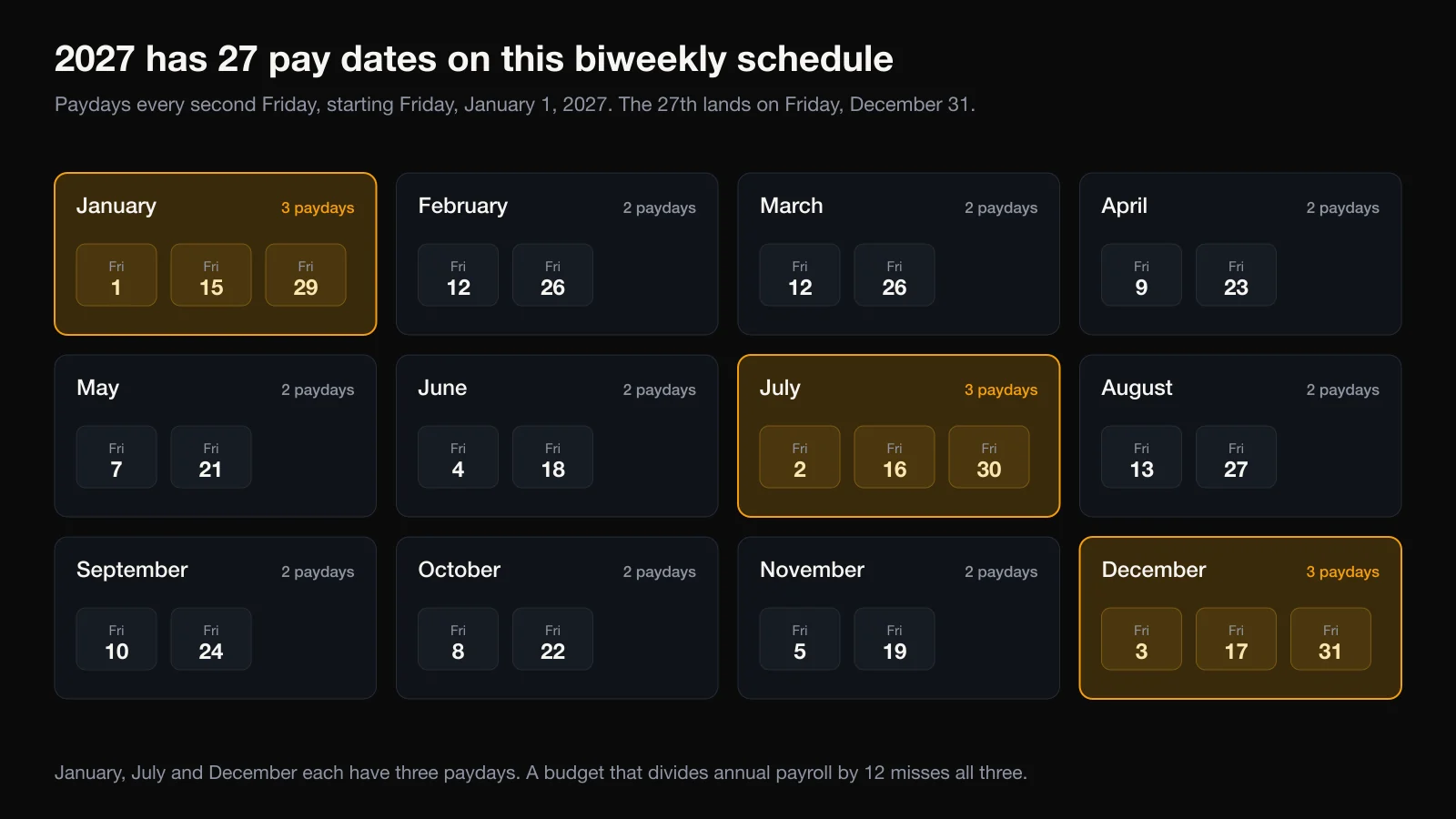
Friday is not the only payday, but the same rule holds for any weekday: 27 pay dates need a payday on January 1. In a leap year, a payday on January 2 also works, because the year is two days longer than 26 periods.
Biweekly schedules that pay on the alternate Fridays, such as January 8, 2027, have 26.
Does 2026 Have 27 Pay Periods?
It can, in two ways.
The two cases:
- A biweekly Thursday schedule with a payday on Thursday, January 1, 2026 has 27 pay dates on the 2026 calendar, ending on Thursday, December 31, 2026.
- A biweekly Friday schedule has 27 pay dates in 2026 if the payday that falls on January 1, 2027 is paid a day early, on December 31, 2026.
The second case is the common one, and it is why the two years get confused.
Why Do Sources Disagree About the Year?
Because January 1 is a bank holiday, and a payday cannot settle on it.
The Federal Reserve's holiday schedule lists New Year's Day 2027 on January 1, a Friday. Direct deposits move over the ACH network, and Nacha, which runs that network, says ACH "payments are not currently settled on weekends and federal holidays."
So an employer with a payday on Friday, January 1, 2027 has to choose. Pay on the last banking day before it, Thursday, December 31, 2026, or pay on the next one, Monday, January 4, 2027.
That one choice moves the 27th pay date:
| When the January 1, 2027 payday is paid | Pay dates in 2026 | Pay dates in 2027 |
|---|---|---|
| Early, on Thursday, December 31, 2026 | 27 | 26 |
| Late, on Monday, January 4, 2027 | 26 | 27 |
The federal government shows the first row in practice. The General Services Administration's 2026 payroll calendar pays every second Friday from January 2. Its December line reads "EFT pay dates: Dec. 4, Dec. 18, Dec. 31". That calendar has 27 pay dates in 2026, and GSA's 2027 calendar has 26.
The same thing happened a year earlier to Thursday schedules. January 1, 2026 was also a holiday, so a Thursday payroll that paid that run on December 31, 2025 has 26 pay dates in 2026, not 27.
Which Year Gets 27 on Your Schedule?
Find your biweekly schedule in this table:
| Your biweekly paydays include | 2026 | 2027 |
|---|---|---|
| Friday, January 2, 2026 and Friday, January 1, 2027 | 26, or 27 if the January 1, 2027 run is paid on December 31, 2026 | 27, or 26 if that run is paid on December 31, 2026 |
| Thursday, January 1, 2026 | 27, or 26 if that run was paid on December 31, 2025 | 26 |
| Any other biweekly schedule | 26 | 26 |
Semimonthly payrolls always have 24 pay dates and monthly payrolls 12. Weekly payrolls follow the same logic as biweekly ones: a Friday weekly payroll has 53 pay dates on the 2027 calendar, and one fewer if the January 1 run is paid in December.
Biweekly is the schedule most likely to be affected. In Bureau of Labor Statistics data for February 2023, it was the most common pay period, used by an estimated 43.0 percent of US private establishments.
How Often Does a 27-Payday Year Happen?
About once every 11 years for any one schedule.
Each year the pay dates fall one day earlier in the calendar, or two days after a leap year. After about 11 years they have drifted a full two weeks, and a payday lands on January 1 again. A schedule with a payday on Friday, January 1, 2027 next has 27 pay dates in 2038, then in 2049.
The US Office of Personnel Management puts it this way for federal employees: "There are usually 26 pay dates each year. Over a period of several years, employees can expect to experience 27 pay days in a calendar year."
What Does the 27th Payday Cost?
One more payroll run in the calendar year: 1/26, or about 3.8 percent, more payroll cash than a normal year.
Take a company whose biweekly payroll run costs $40,000, including payroll taxes and benefits.
| 26-payday year | 27-payday year | |
|---|---|---|
| Payroll runs | 26 | 27 |
| Payroll cash for the year | $1,040,000 | $1,080,000 |
| Months with two paydays | 10, at $80,000 each | 9, at $80,000 each |
| Months with three paydays | 2, at $120,000 each | 3, at $120,000 each |
The extra $40,000 is not the only effect. A budget that divides annual payroll by 12 expects about $86,667 a month. No month actually costs that. Nine cost $80,000 and three cost $120,000.
On the 2027 Friday schedule in the figure above, the three-payday months are January, July, and December. If January's first run is paid on December 31, 2026, the third run moves into December 2026, which then has three.
What About Salaried Employees?
There are two common approaches, and they produce different paychecks.
For an employee on a $78,000 salary:
| Approach | Each paycheck | Paid in the 27-payday year |
|---|---|---|
| Keep paying salary divided by 26 | $3,000.00 | $81,000 |
| Divide the salary by 27 for that year | $2,888.89 | $78,000 |
The federal government uses the first approach for its own staff. OPM's fact sheet continues: "Therefore, employees can actually receive more or less than their annual rate of basic pay in a given calendar year."
The second approach keeps the annual total fixed but cuts every paycheck by about 3.7 percent, and it has a floor. To be exempt from overtime, the federal regulation at 29 CFR 541.600 requires a salary "of not less than $684 per week", which it says is met when an employee is "compensated biweekly on a salary basis of not less than $1,368". The test is per pay period, not per year.
That matters near the threshold. An exempt employee on $36,000 a year is paid $1,384.62 every two weeks on a 26-paycheck basis, which clears $1,368. Divide the same salary by 27 and each paycheck is $1,333.33, which does not.
We found no federal rule saying which approach a private employer must use. That is set by employment agreements and state law, which is why this is a question for counsel before the year starts, not in December.
What Happens to Deductions and Benefits?
Annual limits do not grow because there is an extra payday.
The IRS sets the limit on 401(k) elective deferrals for the year, not per paycheck: $24,500 in 2026. An employee who wants to reach that limit contributes $942.31 a paycheck over 26 paychecks, or $907.41 over 27.
The same arithmetic applies to anything set as an annual amount and deducted per paycheck:
- retirement contributions and employer matches
- health insurance premiums
- flexible spending account elections
Ask your payroll provider how each one is handled in a 27-payday year before the first run of that year.
How Do You Check Your Own Schedule?
Four steps:
- Find your first pay date of the year and your pay frequency.
- Enter both in the payroll calendar calculator. It lists every pay date in 2026 and 2027 and marks the months with three paydays.
- Look for a pay date on January 1. If there is one, ask your payroll provider which day that run will actually be paid.
- Count again with the real date. The calculator works from the calendar, so it will not move a holiday payday for you.
How Do You Put It in Your Cash Forecast?
Put every payroll run in the week it is paid.
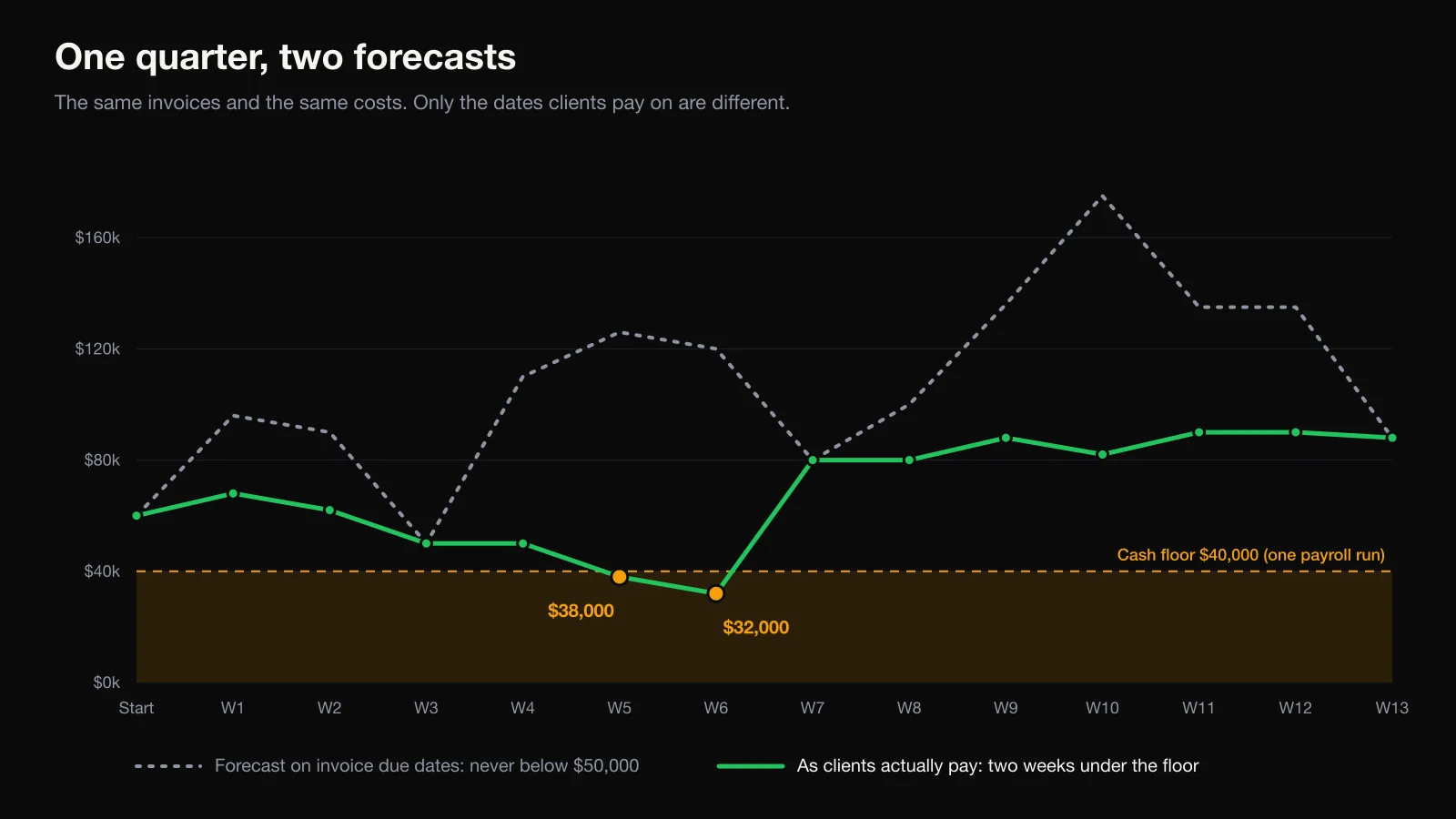
A 27th payday is invisible in an annual budget and obvious in a weekly forecast. So are three-payday months, which happen every year, not once in 11.
In practice:
- List the actual pay dates for the next 13 weeks. Do not spread payroll evenly across months.
- Add payroll taxes and benefits to the same weeks.
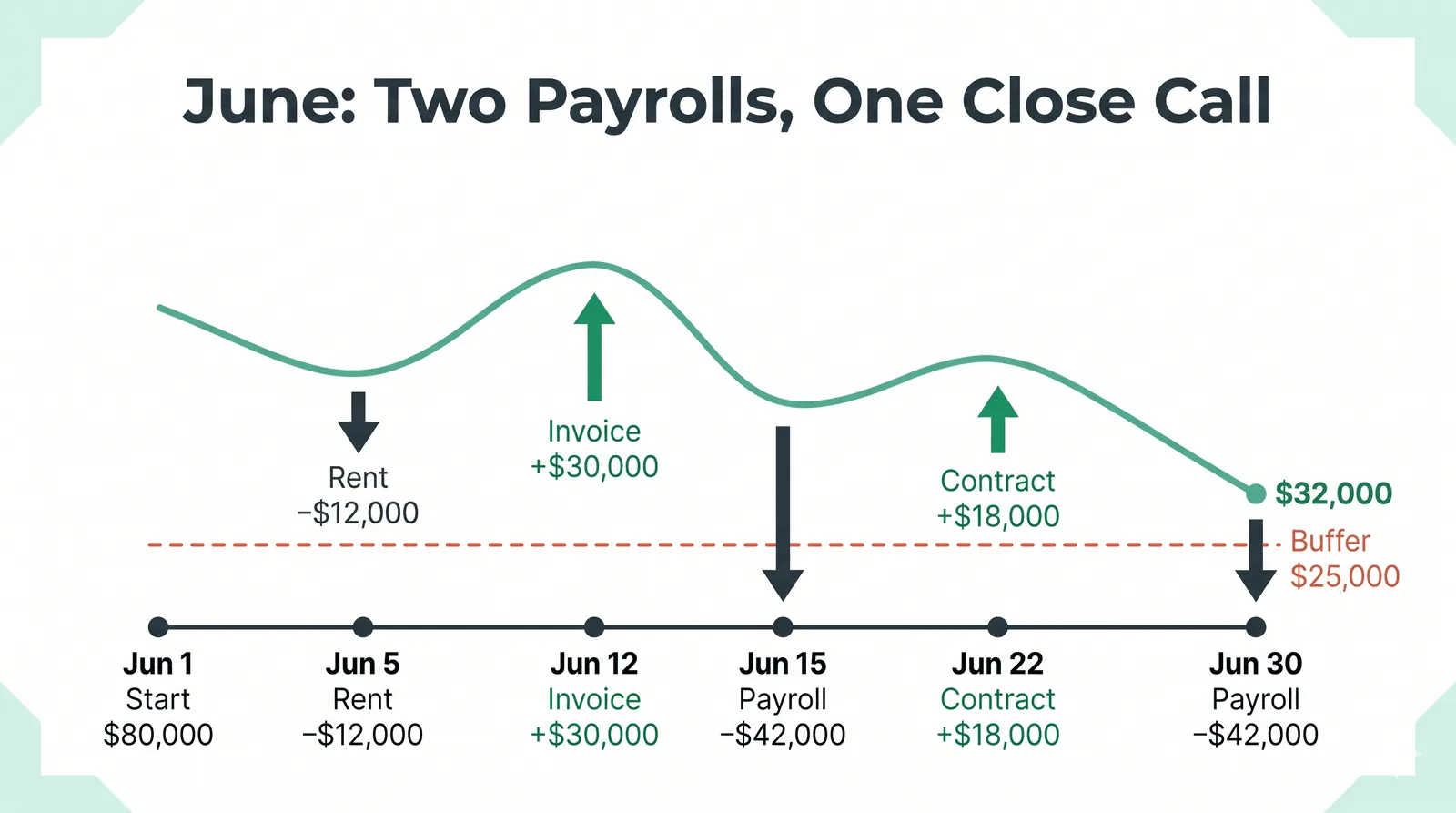
- Check the closing balance after each run against the lowest balance you are willing to hold.
- Look one quarter further out for the next three-payday month.
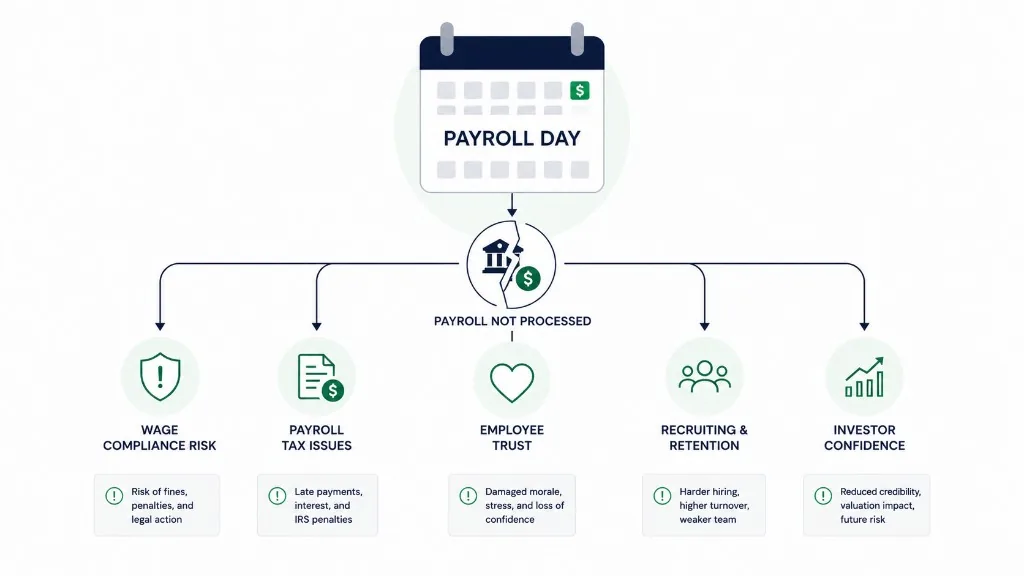
The method is in will I make payroll, and the spreadsheet to do it in is in how to build a 13-week cash flow forecast in Excel. If a run is already at risk, read what happens if you miss payroll.
How Does Zensus Handle Payroll Timing?
Zensus reads your bank transactions through Plaid, finds the recurring payroll debits, and works out their rhythm: weekly, biweekly, semimonthly, or monthly. It then places each future run on its own date in the projection, so a three-payday month shows as three outflows, not as a monthly average.
You can move between monthly, weekly, and daily views or open a 13-week view, and a Slack alert fires when the 30-day projection drops below the cash floor you set. Plans are on the pricing page.