Last week, I got a message from a founder who was panic-checking their bank account.
"Will I make payroll?"
And yes, there was enough money in the account.
But they were asking the wrong question.
Their payroll provider needed to pull funds on a different day than when their employees got paid. Between that submission deadline and the actual deposit, money was going out: rent, vendor invoices, that one customer who was four days late with a $24,000 payment.
Will they make payroll?
The answer depends on how much cash they'll actually have when the provider needs to withdraw funds, not what's in the account today, and not when employees are scheduled to get paid.
The Three Dates That Trip Up Most Founders
Here's where most business owners get caught off guard:
- Employee payday: when staff receive their direct deposit
- Payroll funding date: when the provider withdraws money from your bank
- Payroll submission deadline: when you need to submit/approve for processing
These aren't always the same day.
I've had businesses approved for payroll on Tuesday, only to find out the provider actually needs funds by Wednesday morning. A $5,000 invoice that cleared Wednesday afternoon? Too late. The payday is Friday.
According to Relay's payroll funding documentation, funding deadlines depend on direct-deposit processing speeds. Some payrolls are funded one business day before payday. Others take four.
So here's what really matters: Will you have enough cleared cash available by your provider's funding deadline?
It's Also About Your Safety Buffer
There's another piece people mix up.
Imagine you have $42,000 available before payroll. Your provider needs to withdraw $28,000.
After funding: $14,000 remains.
If your business has a preferred cash reserve of $15,000, you're technically below that floor by $1,000.
But can you still pay your team? Yes.
These are two separate issues:
Payroll funding shortfall: Balance < provider withdrawal means will miss payroll
Cash reserve shortfall: After payroll < preferred reserve means warning: low buffer
One means your employees don't get paid. The other means you're financially exposed but can still hit their direct deposits.
A good forecast should show you both.
What You Need to Know (Not Just What You Need to Count)
You don't need a financial model or Excel spreadsheet to figure this out.
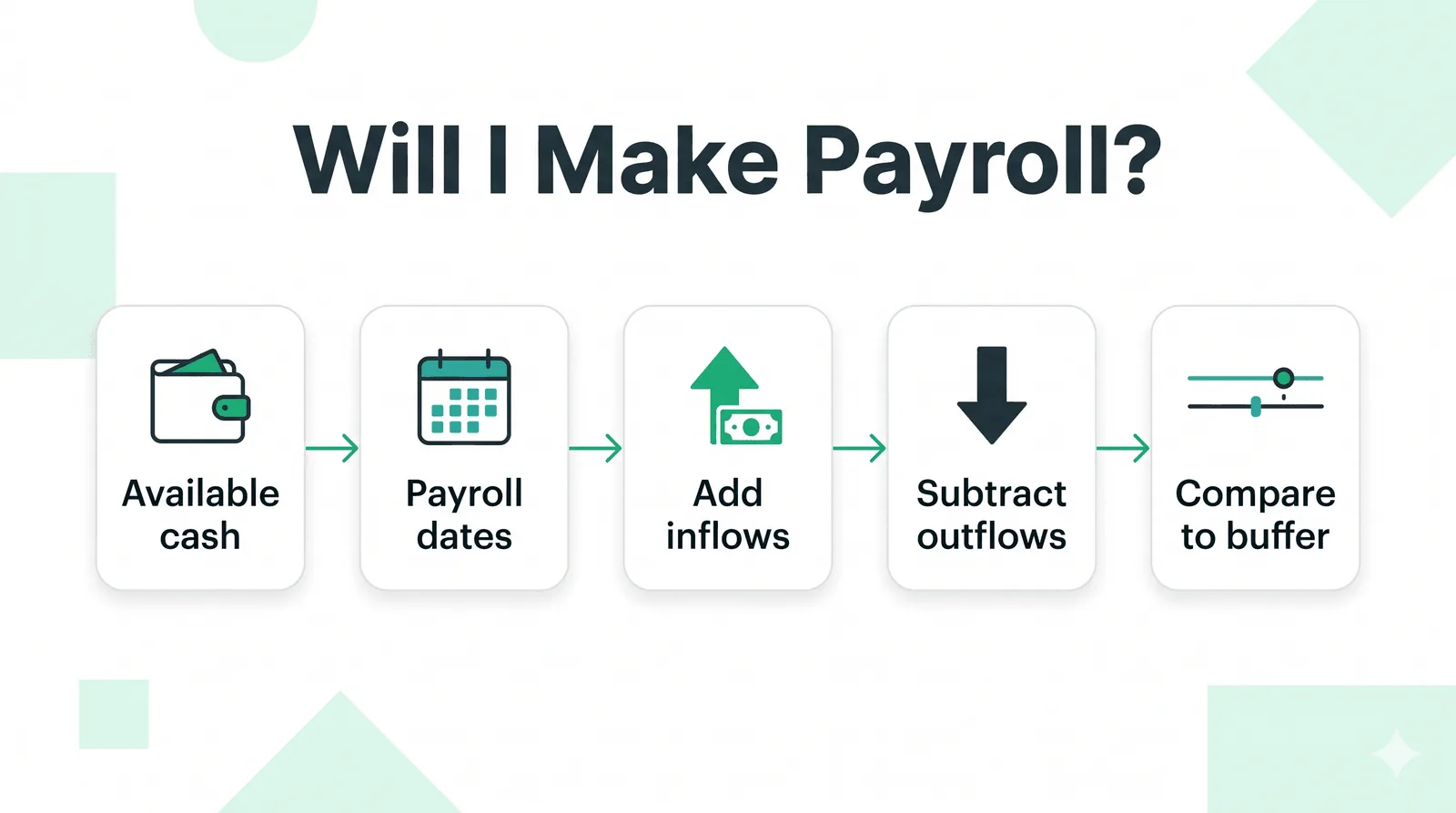
You need five pieces of information:
1. What's Actually Available Now
Start with what's genuinely usable in your business bank accounts.
If you're on multiple banks, count them all. Then subtract:
- Restricted funds
- Pending withdrawals (the ATM swipe, transfer you triggered)
- Outstanding checks that haven't cleared
- Other commitments already pulling cash
Important: If you're already planning to pay something, don't subtract it again as a future event. Transfers between your own accounts don't create new cash. They just move it.
Your starting balance is what you actually have to work with.
2. Your Next Two or Three Payroll Runs
This is where most people miss the mark.
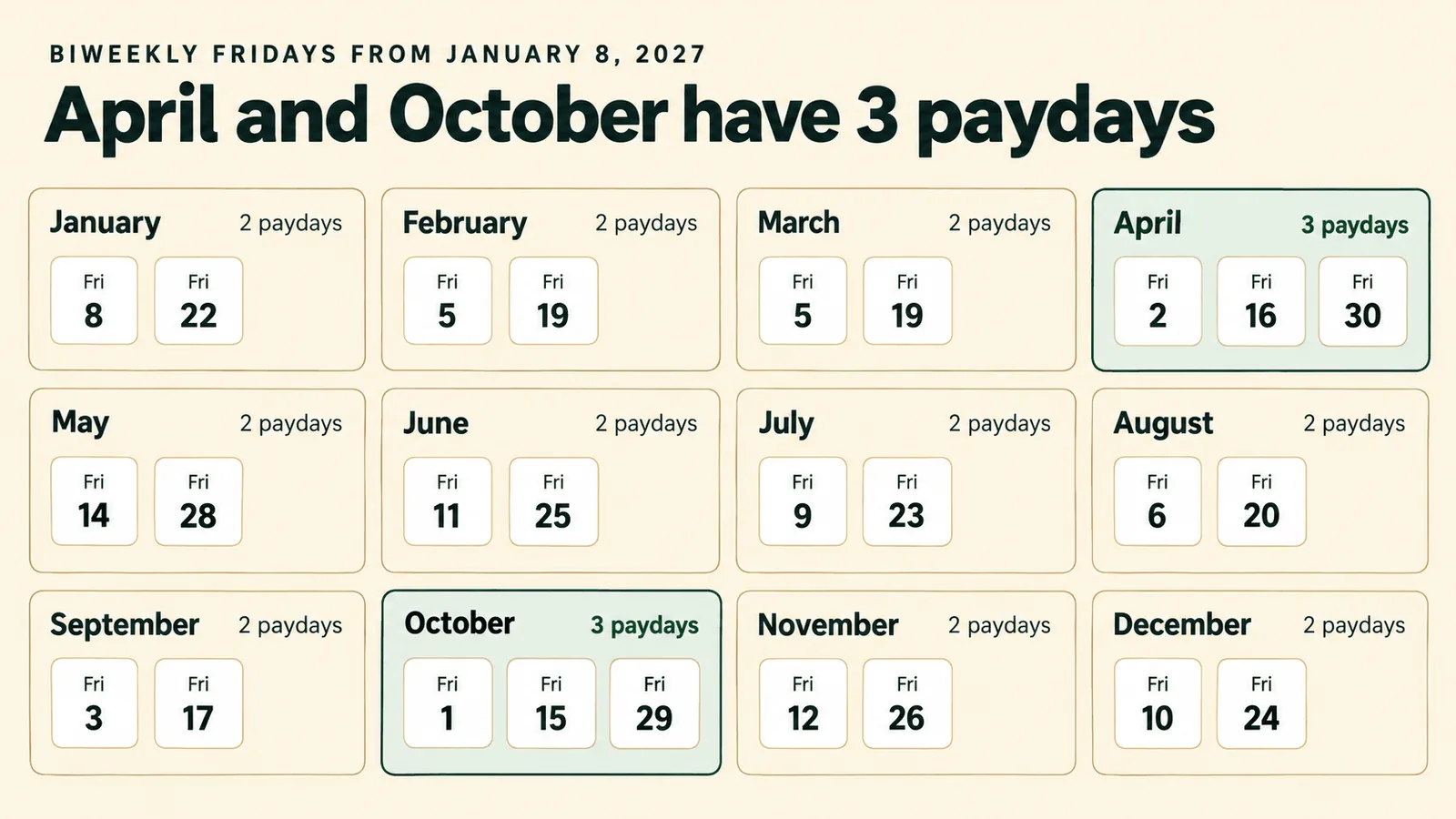
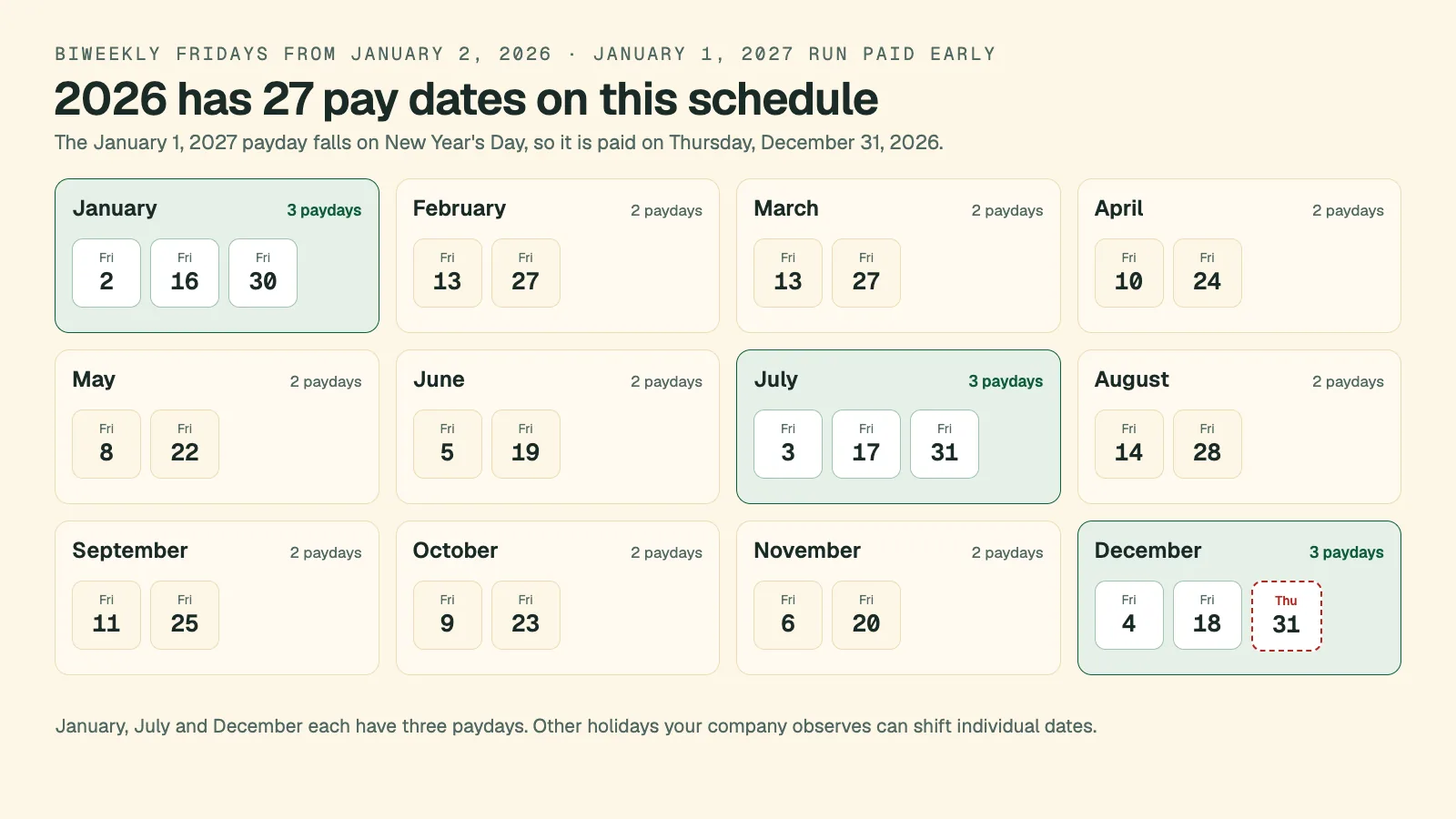
If you run payroll biweekly, you need to forecast two cycles. That's about four weeks. Some months have three paydays; check the payroll calendar for your exact schedule.
For each run, you need:
- Submission deadline
- Provider funding date
- Total amount they'll withdraw
Watch out: Your employees might take home $25,000 in net pay, but the provider could charge you $35,000 that week because of withheld taxes and benefits you're paying separately. Don't assume net pay equals the withdrawal amount. Use what the provider preview actually says.
3. Money Coming In
Now, what's expected before that funding deadline?
- Unpaid customer invoices
- Subscription recurrences
- Retainers
- Loan or financing proceeds
Here's the catch: Use the clearing date, not the invoice due date.
A customer's $25,000 invoice is due November 10th, but they've been paying 10 days late. Does that money actually hit your account by the 10th? Probably not. If you count it on the due date, your forecast looks fine, until it isn't.
Separate "we expect this" from "this is confirmed." And leave out speculative future sales.
4. Other Money Going Out
Before the payroll withdrawal, what else is pulling cash?
- Rent
- Vendor bills
- Loan payments
- Software subscriptions
- Insurance
- Taxes
Payroll taxes need a note: The IRS has its own deposit schedule. If your provider already pulls a tax amount and remits it, don't count that same tax again as your own separate payment. Easy way to get confused and overstate your cash needs.
5. What You Want Left After
Finally, how much cash do you want to have on hand after payroll?
This isn't a legal minimum, just a number that keeps you safe. Maybe you need $15k to cover a month of fixed costs before the next customer payment arrives. Maybe you're adding a sales commission this cycle.
Your cash floor is your own rule, not something someone told you is required.
The Simple Math (That Most People Skip)
Once you've got these five pieces, here's what you calculate:
Available cash before payroll = Starting usable cash + Receipts that clear before the funding date − Other payments you need to make
Now compare that to what the provider needs:
Funding gap = max(0, provider withdrawal − available cash)
- If the gap is $3,000, you're $3,000 short at the funding deadline.
- If the gap is $0, your forecast shows you should be okay.
Then what's left?
After payroll = Available cash before − provider withdrawal
And finally, check against your reserve:
Reserve gap = max(0, your preferred floor − after-payroll cash)
These four numbers tell you:
- Can the payroll be funded?
- How much cash will remain?
- Will you still be above your reserve?
- Where's the first point of risk?
Pro tip: Check the projected balance on key dates too, right before every major transaction. A temporary dip to $500 before the payroll cuts through is just as important as the post-funding balance.
The Real Test: Stress-Test Your Numbers
A forecast should show one version of reality, but your forecast should also show what breaks.
Stress Scenario 1: Your Biggest Customer Pays Late
You expect $25,000 three days before payroll. But they pay 14 days late?
That money isn't available for the withdrawal.
Shift the expected receipt by 7, 14, or 21 days and recalculate. Watch which payroll run turns red.
Stress Scenario 2: Your Funding Date Moves Up
Payday's Friday. You planned on a Thursday funding date. The provider changed the cutoff to Tuesday?
Same cash you have now. Suddenly, it isn't enough.
This is why you need to track funding dates, not just when employees get paid.
Stress Scenario 3: That One Commission Payment
Your sales team crushed it. Next week's payroll includes an $8,000 commission on top of the regular $28,000.
If your forecast still assumes $28,000, you're blind to that $8,000 surprise.
Track variable compensation separately. And if you're on a biweekly schedule, remember that some months have three payroll runs. Annual salary costs stay the same, but your cash needs spike.
These aren't "what ifs." These are scenarios you should run before approval day.
How Far Out Do You Need to Look?
Minimum: Two payroll cycles. For biweekly pay, that's four weeks out.
But a rolling 13-week forecast catches bigger problems earlier.
Imagine you'll have enough for the next two payrolls, but six weeks out: quarterly taxes, a $50k loan payment, and another payroll all land in the same week. That's where the real risk lives.
A 13-week view helps you see when obligations start competing for the same cash.
A weekly forecast is useful for spotting trends. But for payroll, you need actual transaction dates. The provider's cutoff matters more than "weekly averages."
For a deeper dive on the 13-week method, we have a dedicated guide here.
How Much Cash Should You Keep After Payroll?
This is where I talk to founders who need a reality check.
A predictable subscription SaaS company has different risks than a boutique agency on a few client invoices. The right buffer depends on:
- What's coming in next
- How lumpy those collections are
- When major customers usually pay
- Whether you have easy access to financing
- What disruption your team can actually handle
Some founders plan for "one more payroll cycle." Others budget three months of operating expenses.
Neither is the magic number for you.
Instead, build your floor around your own risks:
- How much for the next payroll?
- When's the next reliable payment due?
- How late could our biggest customer be?
- What happens if a major client doesn't pay this month?
- Which bills can't move without serious consequences?
Here's the data point: Gusto's 2026 payroll liquidity research found about one-third of small businesses in its analysis had at least one payroll when balances didn't cover wages.
The good news? Many bridged the gap through transfers, short-term financing, or early invoice payments. The distinction matters: a temporary dip isn't the same as missing a paycheck.
Bottom line: Your reserve is a warning signal, not a legal obligation. But it should tell you whether you're about to get tight.
Your Weekly Payroll Checklist
Payroll forecasting isn't something you do once and forget.
Set aside time each week, even when things look fine. Use this:
- Bank balance reconciled (cleared only)
- Next 2–3 payroll funding dates confirmed
- Total provider withdrawal amounts verified
- Customer invoices reviewed (due dates and expected clearing)
- Vendor payments, loans, subscriptions updated
- Taxes scheduled (if separate from provider)
- Cash balance checked right before each funding deadline
- First at-risk payroll identified (if any)
- Post-payroll cash above preferred floor?
- Tested delayed collections or higher payroll?
If a major invoice clears, a customer delays payment, or an expense shifts, refresh the forecast.
Then 48 hours before your provider's cutoff, double-check: actual cash on hand, exact withdrawal amount, and processing timeline.
Turn this into a routine, not a panic-button moment.
Tools That Actually Help
You could build this in a spreadsheet. It works, if you're disciplined about updates.
Every cleared invoice, every new vendor bill, every late payment changes the picture. A forecast from Monday could be outdated by Thursday.
Bank data shows what actually moved. QuickBooks (or similar) shows what's recorded. Payroll providers show what you're actually charged.
Each answers a different question:
- Bank feed: Real cash in and out
- Accounting software: What you think will happen
- Payroll preview: What you'll actually owe
A payroll-focused forecast connects these: it takes forward-looking accounting estimates and overlays the actual provider withdrawal schedule.
That's the difference between "I think I'll make payroll" and "Here's exactly when the risk starts."
We built free tools for this: the payroll calendar lists every payday on your schedule for 2026 and 2027, and the 13-week cash flow template lays out your next payrolls, expected collections, committed bills, and your desired reserve week by week, and flags any week below your floor. No email required.
The Takeaway
Making payroll shouldn't feel like a guessing game.
It shouldn't depend on whether a customer conveniently pays on the day it's due.
And it shouldn't depend on today's balance.
The question is: Do you have enough cleared, available cash on the date your provider needs to withdraw funds?
Start with that date. Forecast the next two or three payroll runs. Plug in realistic collections and committed payments. Test scenarios where things go wrong.
And keep your cash reserve separate from the minimum needed to hit payroll.
The sooner you spot a potential shortfall, the more options you have before it becomes a problem.
That's what effective cash flow forecasting should feel like: control before the crisis hits.
Try the free 13-week cash flow template
Disclaimer: This article provides general financial planning guidance for U.S. businesses. It's not legal, tax, or compliance advice. Confirm payroll processing and funding deadlines with your provider. Review wage and tax requirements with qualified advisers. Forecasted receipt dates are assumptions: actual settlement depends on customer behavior and bank processing.
Related guides:
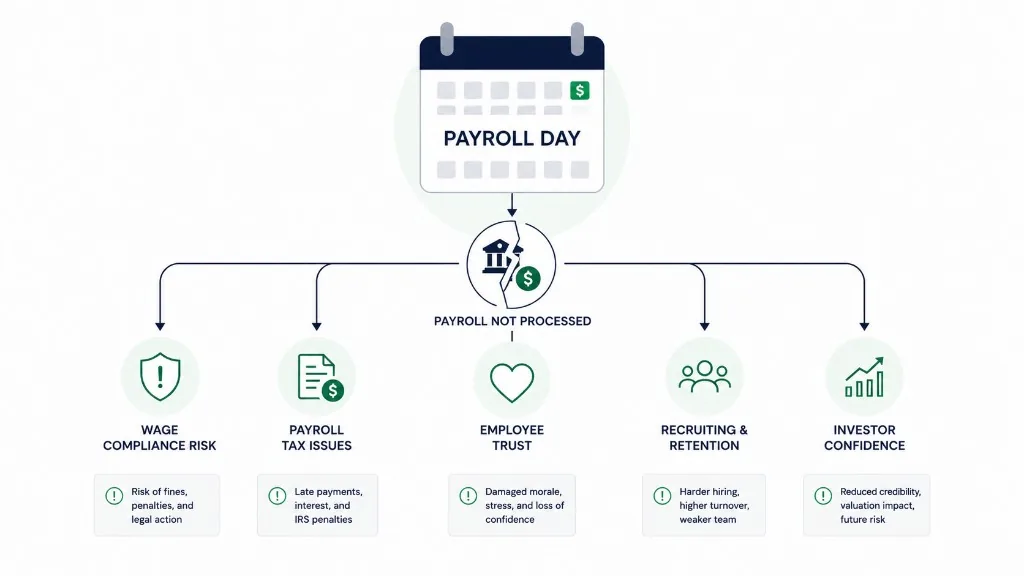
- What happens if you miss payroll?: our missed payroll playbook, with a 7-day plan.
- 27 pay periods in 2026 or 2027?: the year with an extra payroll run.
- What is a 13-week cash flow forecast?: the rolling weekly model.
- Cash flow early warning system: setting a cash floor and alerts.