Every payroll creates a second bill. The paycheck goes out on payday, but the taxes you withheld and the employer's share go to the IRS a few days or a few weeks later, on dates set by the IRS, not by you.
Miss one of those dates by a single day and the IRS charges a penalty. Plan for the wrong one and your bank balance dips on a day you didn't expect. This guide lists every federal payroll tax date for 2027, explains which deposit schedule applies to you, and shows when the cash actually leaves your account.
Quick Answer
Payroll taxes are deposited either monthly, by the 15th of the next month, or semiweekly, a few days after each payday. Which one depends on how much tax you reported in a 12-month lookback period. Form 941 is filed every quarter, and in 2027 it is due Feb 1, Apr 30, Aug 2 and Nov 1, because three of the usual dates fall on weekends. Forms 940 and W-2 are due Feb 1, 2027.
What counts as payroll taxes, and who pays them
When you run payroll, three groups of federal tax are involved:
- Federal income tax withheld from each employee's pay.
- Social Security and Medicare, which you withhold from the employee and match as the employer: 6.2% each for Social Security, up to the 2027 wage base of $192,300, and 1.45% each for Medicare.
- Federal unemployment tax (FUTA), paid only by the employer, usually 0.6% on the first $7,000 of each employee's pay.
The first two are deposited together and reported on Form 941. FUTA is deposited separately and reported once a year on Form 940. State unemployment and state income tax have their own deadlines, covered below.
For the full cost of each line, see our guide to payroll forecasting for 2027.
Monthly or semiweekly: which deposit schedule are you on?
You don't choose your schedule. The IRS sets it each year from the taxes you reported in a lookback period: for Form 941 filers, the four quarters ending June 30 of the year before. For 2027, that is July 1, 2025 through June 30, 2026.
| Taxes reported in the lookback period | Your 2027 schedule | When each deposit is due |
|---|---|---|
| $50,000 or less | Monthly | By the 15th of the following month |
| More than $50,000 | Semiweekly | Paydays Wednesday to Friday: by the following Wednesday. Paydays Saturday to Tuesday: by the following Friday |
Three rules override the table:
- New businesses are monthly depositors in their first calendar year.
- The $100,000 rule. If you build up $100,000 or more in taxes on any day, you must deposit by the next business day, whatever your schedule. A monthly depositor who triggers the $100,000 rule becomes a semiweekly depositor for the rest of that year and all of the next.
- The $2,500 rule. If your total Form 941 tax for the current or previous quarter is under $2,500, and you haven't hit the $100,000 rule, you can pay with your return instead of depositing.
All federal tax deposits must be made electronically. If you use EFTPS, the IRS's payment system, schedule each payment by 8 p.m. Eastern time the day before it's due.
The 2027 payroll tax calendar
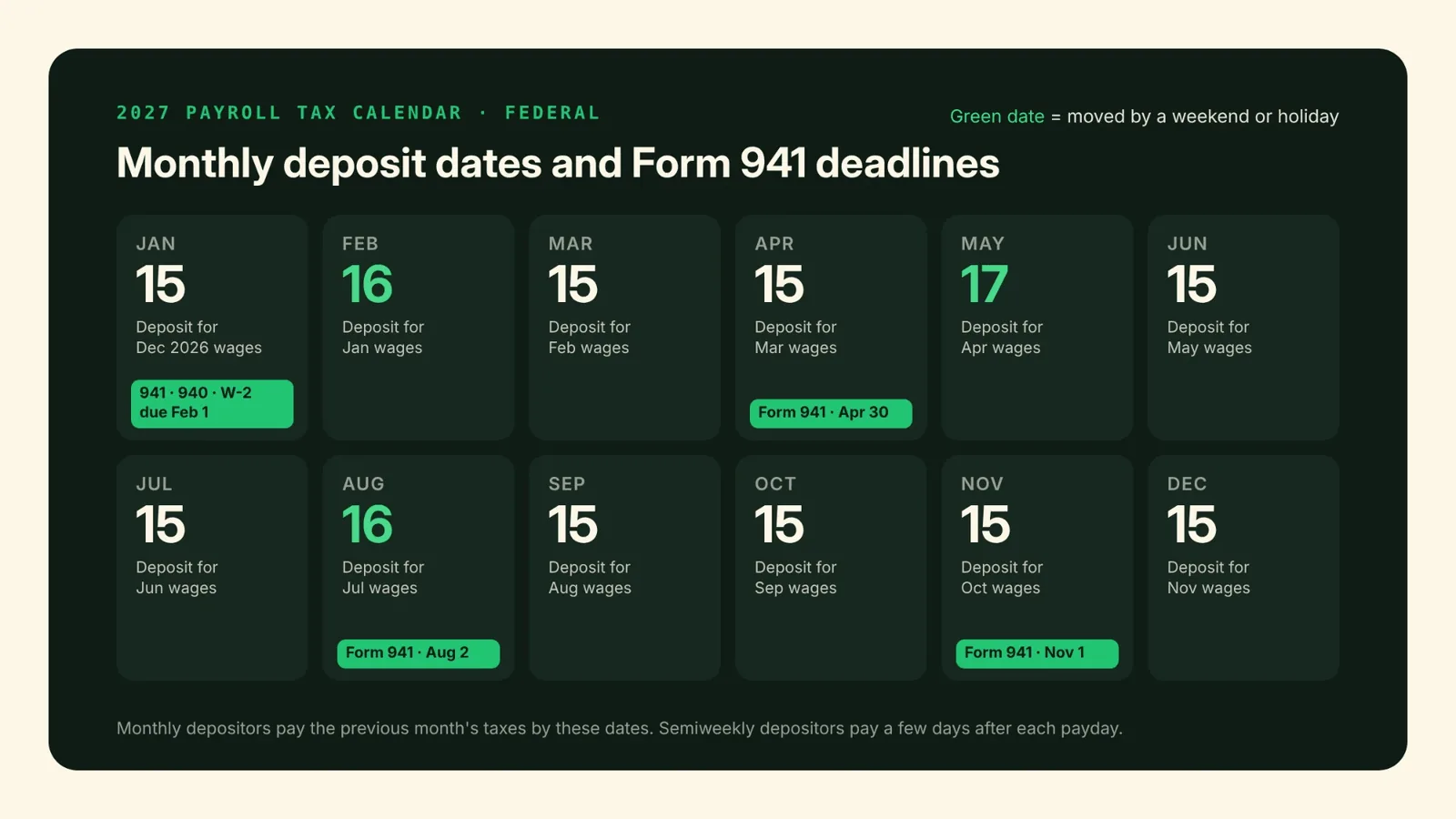
When a deadline falls on a weekend or a legal holiday, it moves to the next business day. The dates below already include that.
Monthly deposit due dates, 2027
| Taxes on wages paid in | Deposit due |
|---|---|
| December 2026 | Friday, Jan 15, 2027 |
| January 2027 | Tuesday, Feb 16 (Feb 15 is Washington's Birthday) |
| February | Monday, Mar 15 |
| March | Thursday, Apr 15 |
| April | Monday, May 17 (May 15 is a Saturday) |
| May | Tuesday, Jun 15 |
| June | Thursday, Jul 15 |
| July | Monday, Aug 16 (Aug 15 is a Sunday) |
| August | Wednesday, Sep 15 |
| September | Friday, Oct 15 |
| October | Monday, Nov 15 |
| November | Wednesday, Dec 15 |
| December 2027 | Tuesday, Jan 18, 2028 (Jan 15 is a Saturday and Jan 17 is Martin Luther King Jr. Day) |
Semiweekly depositors don't have fixed monthly dates: each deposit follows a payday. A Friday payday is deposited by the following Wednesday, so a payroll paid on Friday, Jan 8, 2027 is due by Wednesday, Jan 13. If a legal holiday falls in between, you get an extra business day, because semiweekly depositors always get at least three business days after the period closes.
Filing deadlines, 2027
| Date | What's due |
|---|---|
| Mon, Feb 1 | Form 941 for Q4 2026; Form 940 for 2026; W-2s to employees and W-2s with Form W-3 to the Social Security Administration |
| Fri, Apr 30 | Form 941 for Q1 2027; FUTA deposit for Q1 if over $500 |
| Mon, Aug 2 | Form 941 for Q2 2027; FUTA deposit for Q2 if over $500 |
| Mon, Nov 1 | Form 941 for Q3 2027; FUTA deposit for Q3 if over $500 |
| Mon, Jan 31, 2028 | Form 941 for Q4 2027; Form 940 for 2027; W-2s for 2027 |
Form 941 due dates for 2027
Form 941 is due on the last day of the month after each quarter ends. In 2027, three of those days fall on a weekend, so the deadline moves to Monday:
| Quarter | Normal due date | 2027 due date | If all deposits were on time |
|---|---|---|---|
| Q4 2026 (Oct–Dec) | Jan 31 | Mon, Feb 1, 2027 | Wed, Feb 10 |
| Q1 2027 (Jan–Mar) | Apr 30 | Fri, Apr 30 | Mon, May 10 |
| Q2 2027 (Apr–Jun) | Jul 31 | Mon, Aug 2 | Tue, Aug 10 |
| Q3 2027 (Jul–Sep) | Oct 31 | Mon, Nov 1 | Wed, Nov 10 |
The last column is a 10-day grace period for filing, not for paying. It only applies if every deposit for the quarter was made in full and on time. Semiweekly depositors also file Schedule B with Form 941, listing their tax by payday.
Form 940, FUTA and W-2 deadlines
- Form 940 reports the year's FUTA tax. The 2026 return is due Monday, Feb 1, 2027, or Feb 10 if you deposited all FUTA tax on time.
- FUTA deposits work differently from Form 941. If your FUTA tax for a quarter is $500 or less, carry it over to the next quarter. Once it's over $500, deposit it by the last day of the month after the quarter ends.
- W-2s go to employees, and to the Social Security Administration with Form W-3, by Monday, Feb 1, 2027.
If your business is in California, your 2026 FUTA rate is 2.1%, not 0.6%: the Labor Department set a 1.5% credit reduction for 2026 because the state hasn't repaid its federal loan. That adds up to $105 per employee to the Form 940 balance due Feb 1, 2027.
What the deadlines mean for your cash
A tax calendar tells you when you're compliant. It doesn't tell you what your bank balance looks like that week. For that, follow one payroll through to the last tax payment.
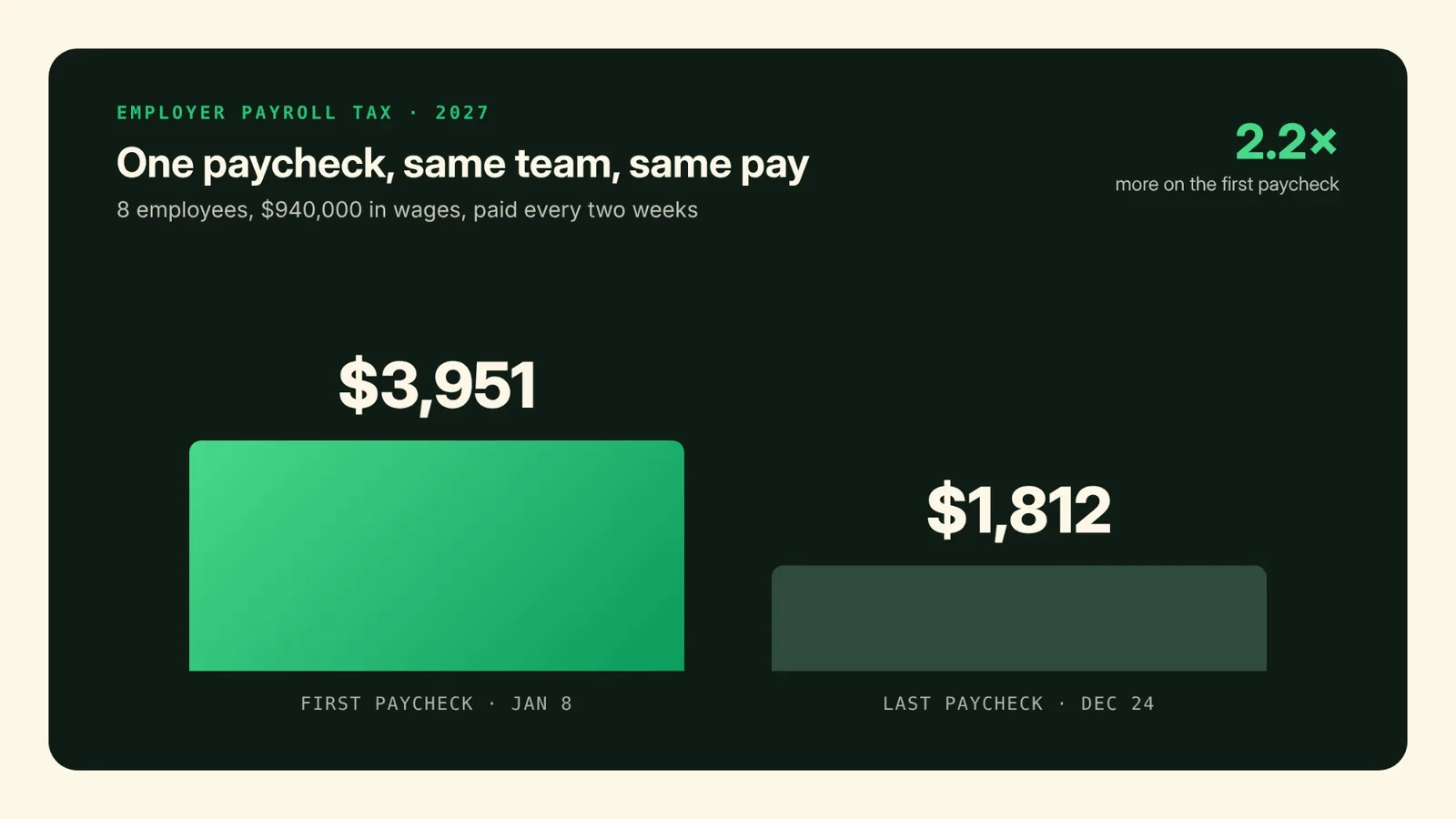
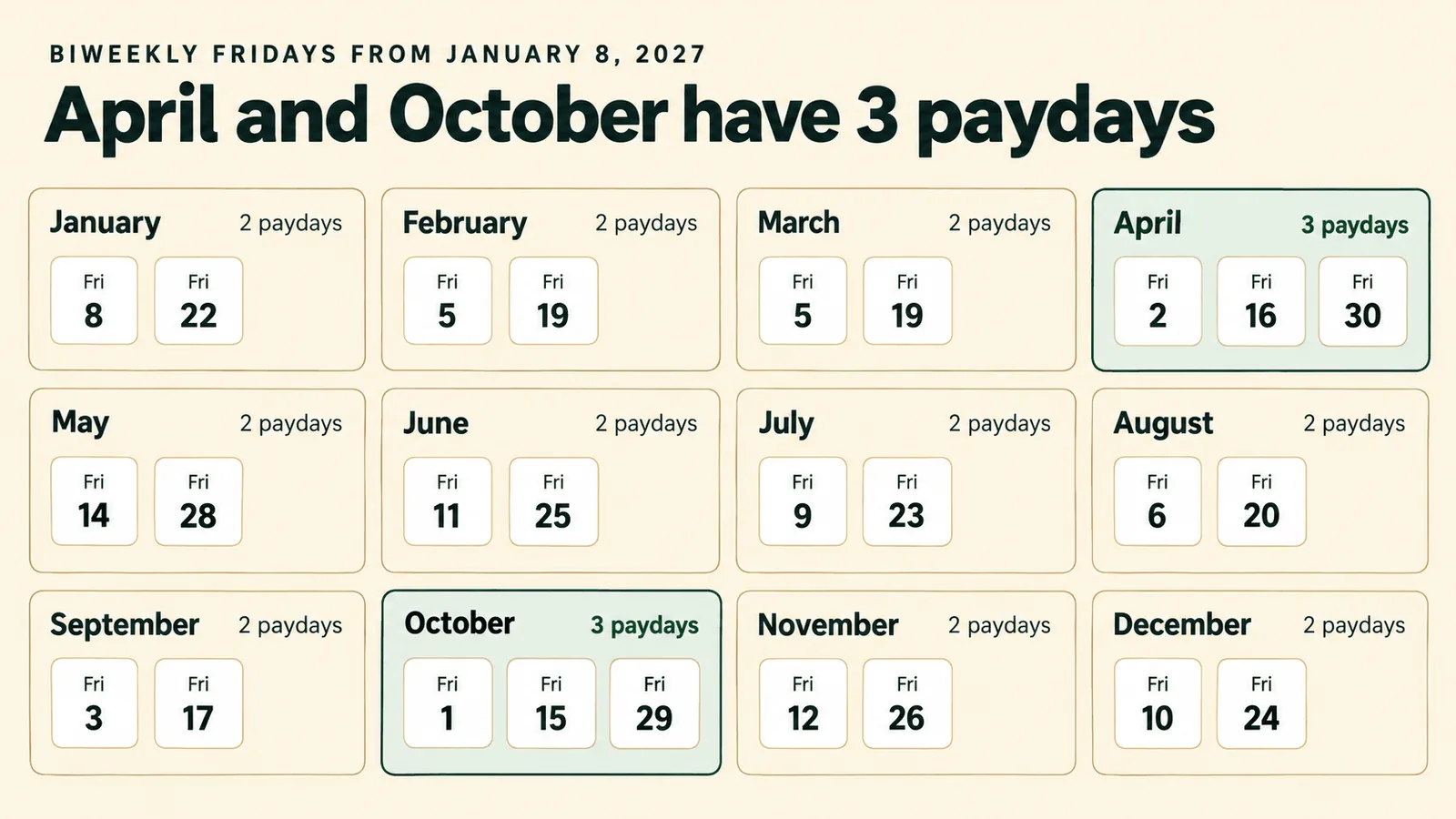
Take the 8-person team from our payroll forecasting guide: $940,000 in annual wages, paid every other Friday from Jan 8, 2027. They report well over $50,000 a year in Form 941 taxes, so they are semiweekly depositors.
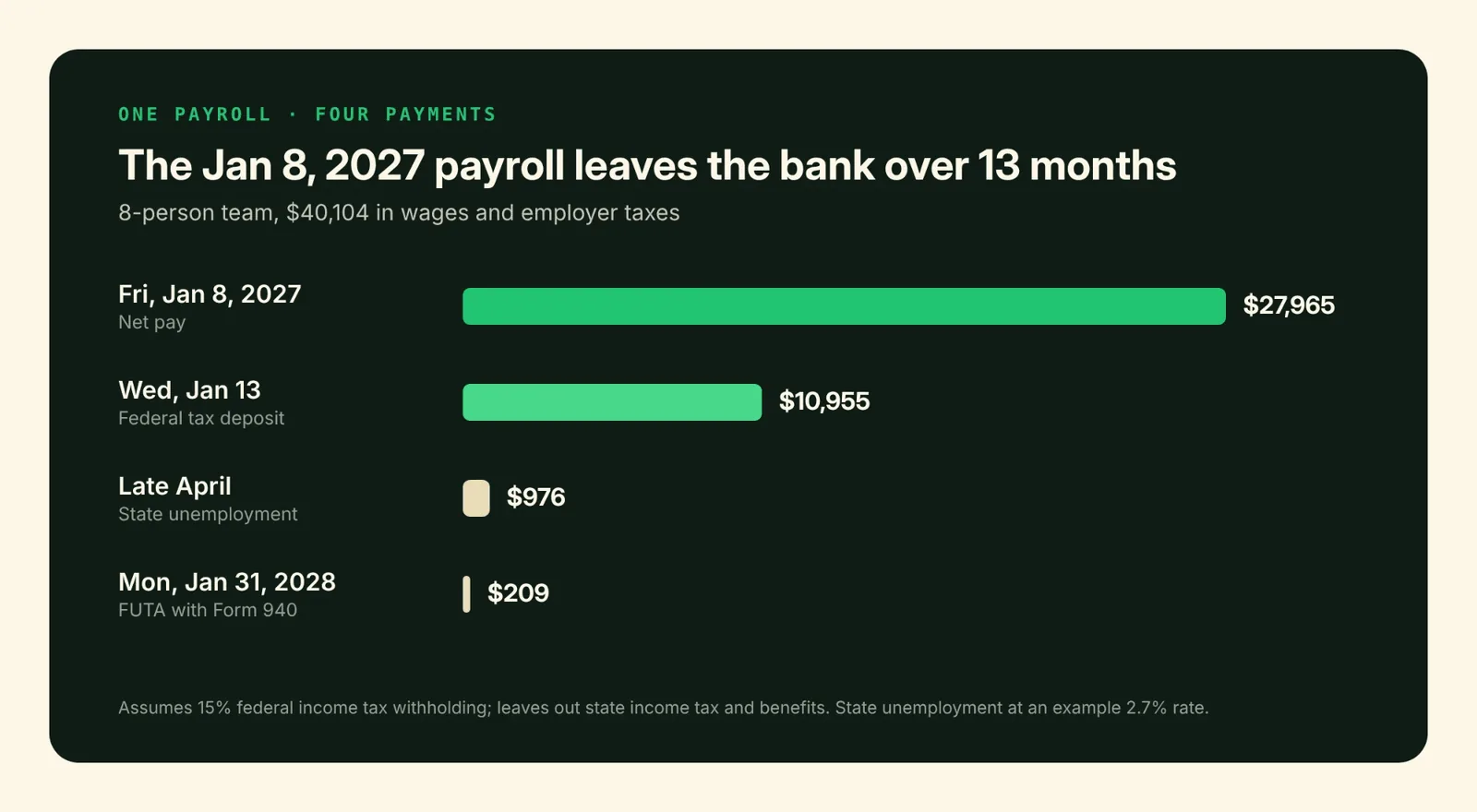
Their first payroll of 2027 costs $40,104 in total: $36,153.85 in wages plus $3,950.54 in employer taxes. It doesn't leave the bank all at once:
| When | Payment | Amount |
|---|---|---|
| Fri, Jan 8, 2027 | Net pay to employees | $27,965.00 |
| Wed, Jan 13 | Federal tax deposit: income tax withheld plus both halves of Social Security and Medicare | $10,954.62 |
| Late April (many states) | State unemployment tax, with the Q1 state payment | $976.15 |
| Mon, Jan 31, 2028 | FUTA, paid with Form 940 | $208.62 |
| Total | $40,104.39 |
Assumes federal income tax withholding of 15% of wages and leaves out state income tax and benefit deductions; your amounts will differ. State unemployment uses the example rate of 2.7% on the first $9,000.
Three things to take from this:
- The tax deposit is about a quarter of the payroll, five days later. A weekly forecast that only shows payday will look $10,955 better than reality for the next five days.
- FUTA can wait a full year. This team's FUTA for the whole of 2027 is $336, never over $500 in a quarter, so it's paid with Form 940 in January 2028.
- Early in the year the deadlines stack up. On top of January's two payrolls and their deposits, Feb 1, 2027 brings Form 940 and any balance for 2026. January is often the tightest month for cash, which is why we use it to size a cash reserve.
To see every 2027 payday for your schedule, use the free payroll calendar. To lay these payments out week by week, use the free 13-week cash flow template.
State payroll tax deadlines
Each state sets its own dates for state unemployment tax and state income tax withholding, and they don't always match the federal ones. State unemployment is usually reported and paid quarterly, often by the end of the month after each quarter. State income tax deposits can be monthly, quarterly or tied to your federal schedule.
Your state's labor or revenue department sends your rates and schedule. If you use a payroll provider, it usually files and pays these for you, but the cash still leaves your account on those dates, so they belong in your forecast.
Penalties for late payroll tax deposits
The IRS charges a failure-to-deposit penalty based on how late the deposit is:
| Days late | Penalty |
|---|---|
| 1 to 5 calendar days | 2% of the unpaid deposit |
| 6 to 15 calendar days | 5% |
| More than 15 calendar days | 10% |
| More than 10 days after the IRS's first notice | 15% |
The penalties don't add up: a deposit 20 days late costs 10%, not 2% plus 5% plus 10%. The 10% penalty also applies to tax paid with the return or directly to the IRS instead of deposited. The IRS also charges interest. Small shortfalls aren't penalized if they're no more than the greater of $100 or 2% of the deposit and you make them up on time.
The bigger risk is the trust fund recovery penalty. The tax you withheld from employees is held in trust for the government. If it isn't paid over, the IRS can hold the people responsible personally liable for 100% of it. If cash is tight, withheld payroll tax is the last bill to delay.
For what to do if payroll itself is at risk, see what happens if you miss payroll.
How Zensus helps
Zensus builds your cash flow forecast from your bank (through Plaid), QuickBooks and HubSpot. Your payroll and its tax payments show up on the dates they actually leave your account, next to the customer payments you're expecting. Set a cash floor, and Zensus sends a Slack alert if your 30-day projection drops below it.
The Bottom Line
In 2027, monthly depositors pay by the 15th of each month, with three dates in 2027 moved by weekends and holidays, and semiweekly depositors pay a few days after each payday. Form 941 is due Feb 1, Apr 30, Aug 2 and Nov 1, and Forms 940 and W-2 are due Feb 1. Put each deposit in your cash forecast on its own date, not on payday, so the week after each payroll doesn't surprise you.
This guide is general information, not tax advice. Deadlines can change, for example after a disaster declaration. Check your deposit schedule and state deadlines with your payroll provider or accountant.
Sources
- IRS: Employment tax due dates
- IRS Topic 757: Forms 941 and 944, deposit requirements
- IRS Publication 15, Employer's Tax Guide
- IRS: Depositing and reporting employment taxes
- IRS: Failure to deposit penalty
- EFTPS: Electronic Federal Tax Payment System
- U.S. Department of Labor: FUTA credit reductions
- Zensus: Payroll forecasting for 2027