Here's the thing about biweekly pay: most months have two paychecks. But a couple of times a year, depending on when you get paid, three paychecks can show up in the same month.
In 2027, that comes down to your specific payday schedule.
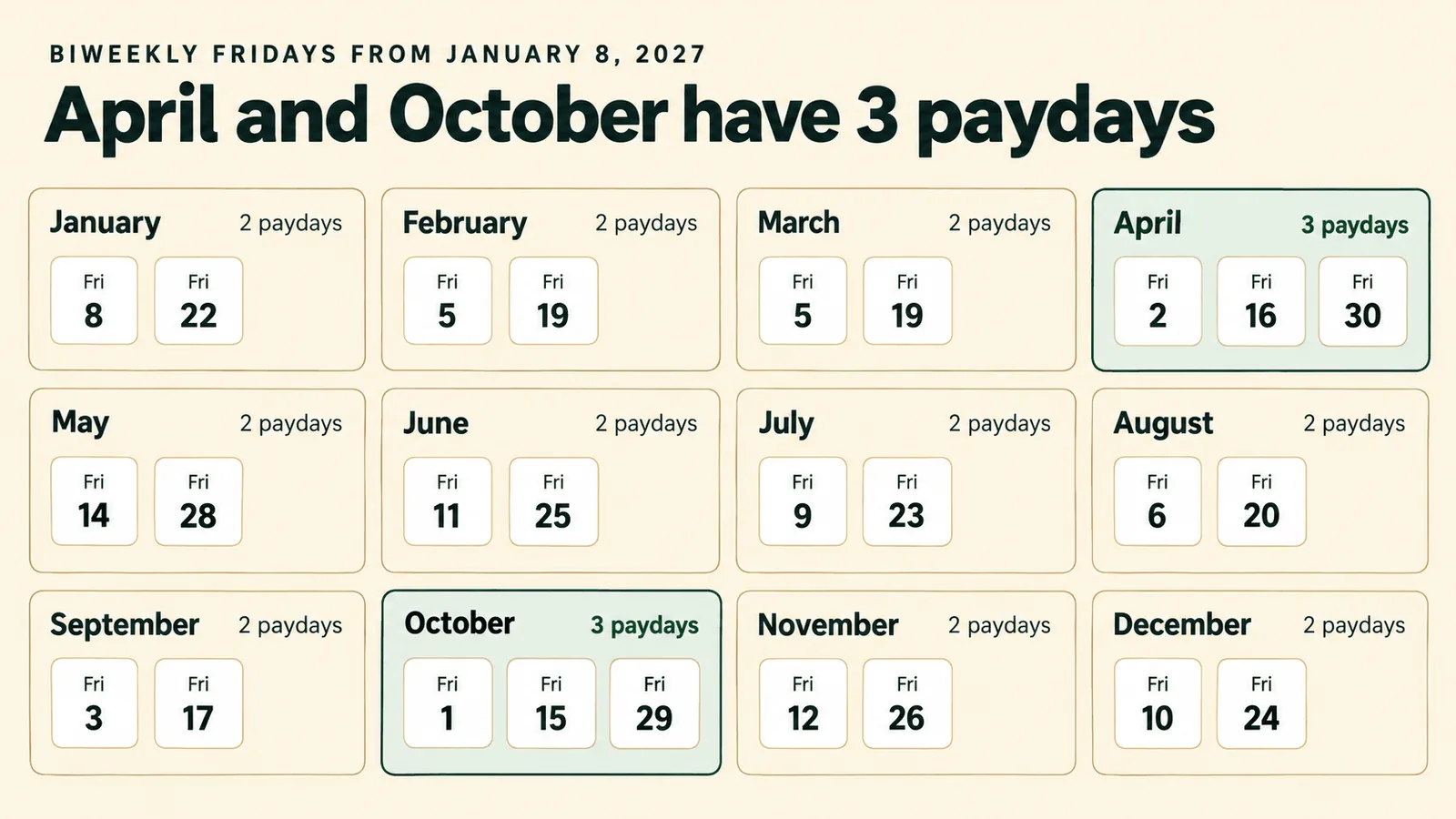
If you're on a Friday schedule starting January 8, your three-paycheck months are April and October.
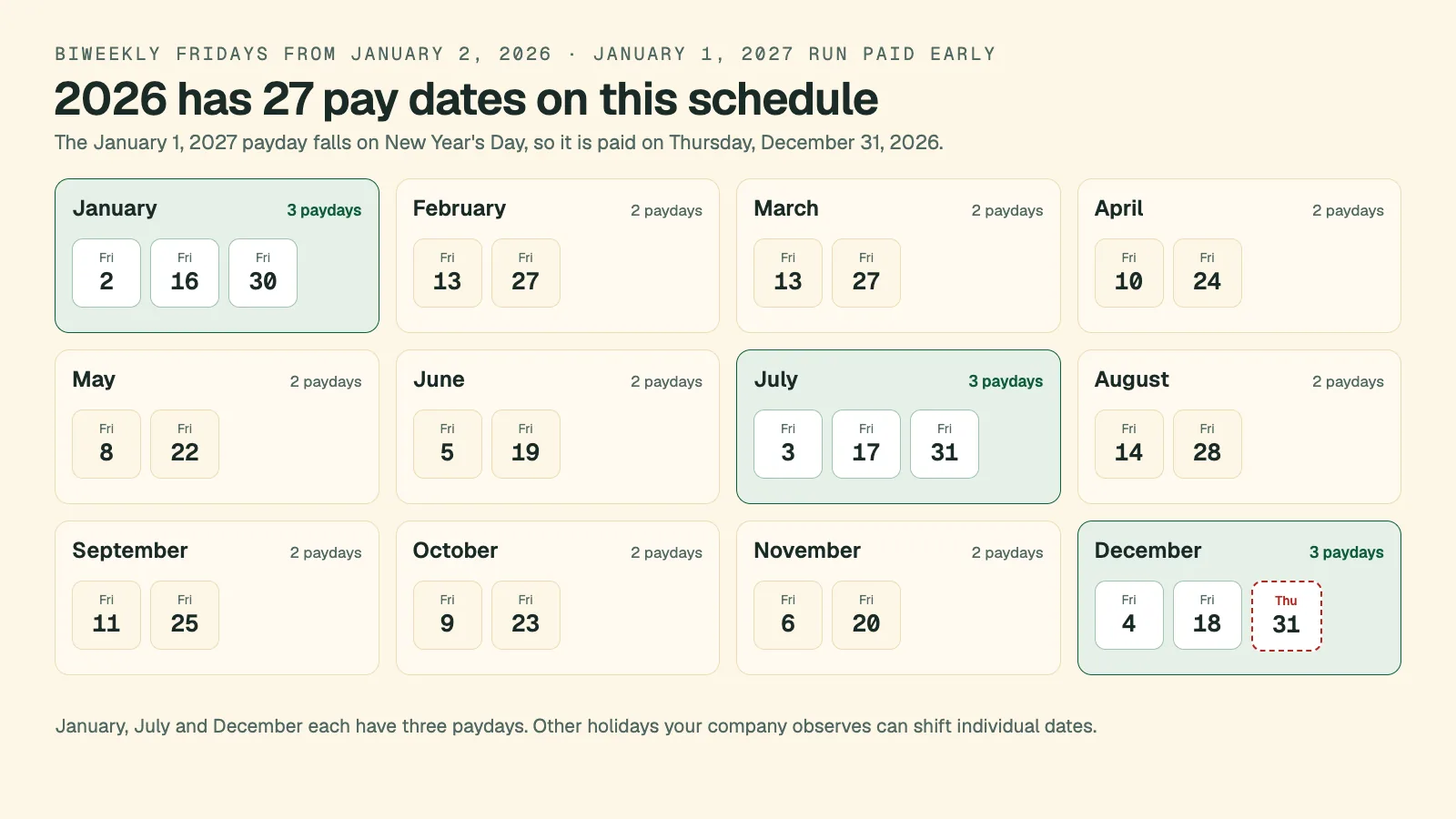
If your schedule nominally starts January 1, the three-paycheck months are January, July, and December, but here's the catch: January 1, 2027, is New Year's Day, a federal bank holiday. If your employer moves that first payday back to December 31, 2026, then your actual three-paycheck months shift to July and December.
| 2027 biweekly schedule | Three-paycheck months | Paydays in 2027 |
|---|---|---|
| Every other Friday, starting January 8 | April, October | 26 |
| Every other Friday, nominally starting January 1 (no holiday adjustment) | January, July, December | 27 |
| January 1 schedule, with that payday moved to December 31, 2026 | July, December | 26 |
These examples assume a consistent 14-day payroll cycle. But here's where it gets interesting: your employer's holiday policy can change the actual dates you receive your paycheck.
Want to figure out your exact schedule? Use the free Zensus Payroll Calendar to calculate your 2027 paydays, identify which months will have three paychecks, and download a printable calendar for your team's records.
Which Months Have Three Paychecks in 2027?
If you're looking for this answer, you're probably relieved to know it depends entirely on when your paychecks actually arrive, not just which biweekly schedule your company uses.
Biweekly means every 14 days. Since calendar months range from 28 to 31 days, some months naturally fit three paydays instead of two.
The fastest way to figure out your three-paycheck months? Just identify when your first 2027 payday lands, then count forward in 14-day intervals.
You're Paid Every Other Friday, Starting January 8
If your employer pays every other Friday beginning January 8, 2027, your three-paycheck months are April and October.
| Month | Payday dates | How many paychecks? |
|---|---|---|
| January | 8, 22 | 2 |
| February | 5, 19 | 2 |
| March | 5, 19 | 2 |
| April | 2, 16, 30 | 3 |
| May | 14, 28 | 2 |
| June | 11, 25 | 2 |
| July | 9, 23 | 2 |
| August | 6, 20 | 2 |
| September | 3, 17 | 2 |
| October | 1, 15, 29 | 3 |
| November | 12, 26 | 2 |
| December | 10, 24 | 2 |
This schedule has 26 nominal paydays in 2027. April and October each have three payroll runs, while all other months have two.
Remember, actual payment dates may be adjusted for bank holidays or weekends.
You're Paid Every Other Friday, Starting January 1
The other common Friday schedule begins on January 1 and continues every 14 days. Without any holiday adjustments, this cycle hits three paydays in January, July, and December.
| Month | Nominal payday dates | How many paychecks? |
|---|---|---|
| January | 1, 15, 29 | 3 |
| February | 12, 26 | 2 |
| March | 12, 26 | 2 |
| April | 9, 23 | 2 |
| May | 7, 21 | 2 |
| June | 4, 18 | 2 |
| July | 2, 16, 30 | 3 |
| August | 13, 27 | 2 |
| September | 10, 24 | 2 |
| October | 8, 22 | 2 |
| November | 5, 19 | 2 |
| December | 3, 17, 31 | 3 |
Here's where it gets tricky. January 1, 2027, is New Year's Day, a federal bank holiday.
Your employer has to decide whether to move that January 1 payday to the preceding business day (December 31, 2026) or the next business day (January 4, 2027).
If they move it back to December 31, 2026, that 2027 schedule only has three-paycheck months in July and December.
If they push it forward to January 4, 2027, January still contains three actual payments.
Bottom line: Two employees on the same nominal Friday cycle could have different numbers of three-paycheck months depending on their company's holiday policy. Use your actual payment dates, not assumptions about what days banks are closed.
Why Do Some Months Have Three Paychecks?
It comes down to calendar math.
"Biweekly" means every two weeks, or once every 14 days. In 2027, there are 52 weeks plus one extra day. Most biweekly schedules hit 26 paydays within a calendar year, though certain schedules and holiday policies can push it to 27.
A calendar month, though, isn't exactly four weeks long.
Picture this: you get paid on these dates.
- Friday, April 2
- Friday, April 16
- Friday, April 30
All three paydays fall inside April. Your next check arrives 14 days later on May 14. Your pay frequency hasn't changed at all; the biweekly schedule just happens to squeeze three payments into one month.
Biweekly vs. Twice-Monthly Pay
It's also worth knowing how biweekly differs from what most companies call "twice-monthly" payroll.
| Payroll frequency | How it works | Typical annual payments |
|---|---|---|
| Weekly | Every 7 days | 52 or 53 |
| Biweekly | Every 14 days | 26 or sometimes 27 |
| Semimonthly | Twice per month, often 15th and month-end | 24 |
| Monthly | Once per month | 12 |
Someone on a semimonthly schedule (like the 15th and last day of each month) gets two paychecks every month.
Someone on a biweekly schedule (like every other Friday) might get three paychecks in certain months.
This distinction matters when you're budgeting for the year, planning your employer's payroll, or forecasting cash flow.
How Many Biweekly Pay Periods Are There in 2027?
Most biweekly schedules have 26 pay periods, so there you go, 52 weeks of work equals 26 biweekly cycles.
But depending on how that 14-day cycle aligns with the calendar, a year can technically have 27 scheduled pay dates.
A January 1, 2027, Friday anchor means 27 scheduled dates between January 1 and December 31. If that first payment gets moved to December 31, 2026, you'll end up with 26 actual 2027 payments.
It helps to think of it this way:
- Pay period: The span of days a paycheck covers (usually one biweekly cycle).
- Scheduled payday: The day you're supposed to get paid on.
- Actual payday: The day your company actually deposits your check.
These are related but not always the same. The difference matters most around year-end, when a scheduled payday can fall into one tax year but get paid in another.
If you want the full breakdown, check out our guide: 27 Pay Periods in 2026 or 2027? How to Tell Which Year Has the Extra Payday.
How to Calculate Your Three-Paycheck Months in 2027
You don't need fancy software for this. You need three things:
- When you actually get paid (your next confirmed payday)
- Your payment frequency (biweekly, semimonthly, etc.)
- How your employer handles holidays
Step 1: Find Your Next Confirmed Payday
Pull up a recent pay stub, check your company's payroll calendar, or log into your payroll provider. Find the actual date money hits your account, not just when your work period ends.
For example, your work period might end December 31, but your employer might not issue the check until the following week.
Step 2: Count Forward in 14-Day Intervals
From your payday, add 14 days repeatedly. January 8 becomes January 22, then February 5, then February 19, and so on.
Keep going through December 2027.
Step 3: Factor in Bank Holidays
Check whether any payday lands on a banking holiday or weekend. Some employers pay on the preceding business day; others have different policies, depending on state laws and what your payroll provider supports.
This is especially important when a payment crosses a month or year boundary.
Step 4: Tally the Payments by Month
Look at your complete list of payday dates and see which calendar months contain three of them.
You could do this in a spreadsheet, or use the free Zensus Payroll Calendar to calculate the whole year at once. The tool lets you enter a payday, choose your frequency, apply holiday adjustments, estimate monthly payroll cash outflows, and export everything for your records.
For an employer, this makes it much easier to spot months when payroll cash requirements spike.
What Do Three-Paycheck Months Mean for Employers?
Here's where perspectives diverge.
For an employee, a three-paycheck month feels like a bonus: three payments instead of two. Maybe they're going to pay off a credit card or make extra toward savings.
For an employer, the question is: Will there be enough cash in the bank when the third payroll runs?
Imagine a small business with 20 employees, spending $40,000 per biweekly payroll run.
In a typical two-paycheck month, they need $80,000 for payroll.
In a three-paycheck month, that jumps to $120,000.
| Scenario | Cash needed |
|---|---|
| Regular two-paycheck month | $80,000 |
| Three-paycheck month | $120,000 |
| Extra cash outflow that month | $40,000 |
That's a 50% increase in payroll cash disbursements for that month.
Crucially, this doesn't mean the business has 50% more labor costs. They're paying the same people at the same rates. The payment schedule just happens to place an extra check within the month.
But cash still has to leave the bank on the scheduled payment date.
And that's where knowing the difference between accounting profit and actual cash in the bank matters.
Why a Profitable Business Can Still Be Short on Payroll Cash
Picture an agency pulling in $200,000 per month. Their typical monthly payroll is $80,000. Rent, contractors, software, and other expenses push regular cash outflows to $140,000. On paper, they're profitable by $60,000 per month.
Now suppose April has three payroll runs. Payroll cash outflows jump to $120,000, bringing total monthly payments to $180,000.
Is this a crisis? Maybe not.
But what if a key client pays two weeks late? Or a couple of invoices hang over while rent and payroll are due?
The business could find itself temporarily short of cash despite having substantial outstanding revenue.
The issue isn't always that they don't have enough money overall. Sometimes it's the timing of cash coming in versus cash going out.
This is why identifying three-paycheck months before the year starts matters.
How to Forecast Payroll Cash Flow Before a Three-Paycheck Month
A traditional monthly budget tells you payroll will cost $120,000 in April. But it doesn't tell you whether you'll actually have the money on April 2, April 16, or April 30.
To know for sure, you need to forecast cash flow on a weekly basis.
A 13-week cash flow forecast projects week-by-week what's coming in versus what's going out: customer collections, payroll, taxes, rent, contractors, and other planned payments.
Example: How a Third Payroll Changes Your Cash Position
Let's say a business starts April with $100,000 in cash. They expect $90,000 in customer payments during the month, and they have $40,000 per payroll run plus $35,000 in other expenses.
Here's what a simple weekly forecast looks like:
| Week ending | Cash in | Payroll | Other expenses | Ending cash |
|---|---|---|---|---|
| April 2 | $10,000 | $40,000 | $10,000 | $60,000 |
| April 9 | $30,000 | $0 | $10,000 | $80,000 |
| April 16 | $5,000 | $40,000 | $5,000 | $40,000 |
| April 23 | $35,000 | $0 | $5,000 | $70,000 |
| April 30 | $10,000 | $40,000 | $5,000 | $35,000 |
| Monthly total | $90,000 | $120,000 | $35,000 | $35,000 |
Mathematically, the business ends April with $35,000 cash.
But here's the scenario where things get scary: what if that $35,000 from the week of April 23 doesn't arrive until May?
The forecast cash balance at April 30 drops to zero.
That's a meaningful difference for anyone responsible for making payroll.
The value of forecasting isn't just knowing the total amount you'll spend. It's knowing when the balance becomes tight, what caused it, and how much time you have to react.
A weekly forecast makes those risks visible.
To learn more about cash flow forecasting, check out What Is a 13-Week Cash Flow Forecast?.
Build Your Cash Flow Forecast Around Actual Payroll Dates
When you're building a 2027 cash flow forecast, don't just average out monthly payroll costs. Start with the actual payment dates from your payroll calendar.
Then model the major cash movements around those dates:
- Employee wages and related disbursements
- Employer payroll taxes and benefit payments
- When you expect to get paid by customers
- Rent, utilities, software, and contractor payments
- Loan payments and other scheduled obligations
For each week, calculate:
Ending Cash = Beginning Cash + Cash Inflows − Cash Outflows
Carry that week's ending balance forward as next week's starting balance.
Then test what happens if a customer pays late, an invoice arrives early, or revenue falls below expectations.
This gives you a much more realistic picture of whether you'll make payroll on any given date.
How Zensus Helps Businesses Plan Around Payroll
Accounting software helps you understand what happened in the past. Zensus is built for what's coming next.
Business owners need to see how payroll, customer payments, and other financial obligations play out over time. When these cash flows are misaligned, a monthly average can hide dangerous gaps.
Zensus focuses on forward-looking cash flow forecasting, helping founders and finance operators understand how different assumptions affect projected cash balances.
For example, a business can evaluate whether losing a key client or an additional payroll disbursement could create cash pressure in the next few weeks.
The objective isn't just to calculate "how many months of runway" remain. It's to understand where cash pressure could appear and when you'll face it.
If you're planning your 2027 payroll schedule, start by identifying your actual payday dates with the Zensus Payroll Calendar. Then incorporate those dates into your cash flow planning so payroll doesn't become an unexpected surprise.
2027 Three-Paycheck Month Planning Checklist
Before 2027 rolls around, business owners and finance teams should work through this list:
- Confirm your actual biweekly pay schedule. Don't assume your schedule matches the company-wide Friday cycle.
- Verify New Year's and other holiday adjustments. A moved payday can change which month or year records the payment.
- Identify months with three payroll runs. Record the specific dates in your operating calendar.
- Calculate the cash needed for each payroll run. Include relevant employer taxes and benefits, not just gross wages.
- Review employee deductions. Check how benefits, retirement contributions, and other deductions are administered.
- Build a rolling cash flow forecast. Include actual payroll dates and expected customer collection dates.
- Test delayed-payment scenarios. Understand whether payroll remains covered if expected receivables arrive late.
- Review the forecast regularly. Update your assumptions as invoices are paid and expenses change.
The earlier you identify a potential payroll shortfall, the more options you generally have to manage it, whether that's negotiating payment terms, drawing on a credit line, or pulling cash from another month's revenue.
Conclusion: Know Your Payroll Dates Before They Affect Your Cash Flow
Three-paycheck months aren't unusual. They're a predictable feature of biweekly payroll.
In 2027, employees on a January 8 Friday cycle have three-paycheck months in April and October. Those on the alternate January 1 cycle need to account for the New Year's Day holiday to determine whether January contains two or three actual payments.
For employees, understanding the calendar can make personal budgeting easier.
For employers, it can prevent unexpected pressure on the bank account.
The key takeaway: Plan around the dates cash actually moves, not just the monthly average.