What Is Cash Flow Forecasting?
Cash flow forecasting is estimating how much money you'll have available in the future, by predicting when money will come in and go out of your business, so you know whether you'll be able to cover your obligations when they're due.
Here's something I've learned the hard way: a profitable business can still run out of cash.
We've all seen the classic story: a company invoices $100,000 in October, its expenses total $70,000, and on paper, it's looking great with $30,000 in profit. But then customers pay in November while payroll and suppliers demand payment in October.
The result? A profitable company that can't pay its bills.
Cash flow forecasting is what keeps you from that situation.
Unlike your P&L statement that tells you about profitability, a cash flow forecast answers the question that actually matters for day-to-day survival:
"Will we have enough cash when we need to pay the rent, the vendors, our team?"
In this guide, I'm walking you through what cash flow forecasting is, how to build one that actually helps you, and how to use it to make smarter decisions.
Why Bother With This?
I get it: you could skip cash flow forecasting if you're profitable, right? I used to think so too.
Let me tell you why that thinking is dangerous:
A business can be profitable on paper but completely cash-strapped in reality. Cash flow forecasting is what bridges that gap.
It helps you:
- See cash shortages coming before they become crises, instead of scrambling at month-end
- Know if you can actually afford that new hire or equipment purchase
- Understand when outstanding invoices will actually turn into cash
- Plan for funding needs before the situation becomes urgent
- Test "what if" scenarios: What if collections are 3 weeks late? What if we take on more debt?
For startups especially, cash forecasting is lifeline money. It connects every spending decision to your runway, helping you make smarter calls about when to hire, when to slow down, and when to seek funding.
The Four Building Blocks
Every cash flow forecast is built on four simple pieces. You don't need a fancy financial model to have these:
1. Where You Start (Opening Cash)
This is the cash you have at the beginning of your forecast period.
If you have $50,000 across all your bank accounts, that's your starting point.
Important: Make sure this is actual available cash, not money tied up in accounts you can't access. I once worked with a company that showed $200,000 in their balance sheet, but $150,000 was in an account they couldn't touch. Their "forecast" was misleading from the start.
2. Money Coming In (Cash Inflows)
This is cash you expect to receive, not necessarily revenue you've earned.
Common examples:
- Customer payments
- Cash sales
- Loan advances or investment capital
- Tax refunds
- Other income you're actually expecting
Here's a mistake I see constantly: treating an invoice as cash. Issuing a $20,000 invoice does not increase your bank balance by $20,000. The cash only comes in when your customer actually pays.
3. Money Going Out (Cash Outflows)
This is cash you expect to pay: salaries, rent, utilities, vendor invoices, loan payments, taxes, equipment purchases.
Crucial distinction: Time matters. Your forecast should track when money leaves your bank account, not when you account for it as an expense.
4. Where You End Up (Closing Cash)
This is what you have left after accounting for all inflows and outflows.
It also becomes your starting point for the next period.
That's it. Four pieces of information and you have a working forecast.
The Simple Formula
Here's how the math works:
Ending Cash = Opening Cash + Cash Inflows − Cash Outflows
Let me walk you through a quick example:
| What | Amount |
|---|---|
| Cash at start | $50,000 |
| Customer payments | $35,000 |
| Operating expenses | $42,000 |
| Cash at end | $43,000 |
Simple addition and subtraction.
You can also calculate net cash flow (inflows minus outflows): in this case, it's negative $7,000.
Now here's where things get interesting: a negative cash flow doesn't mean failure. It just means more cash is leaving than coming in this period. What really matters is whether you have enough cash on hand to cover it.
Real Example: The Week-Long Crisis
This is the part that blows my mind every time I see it.
Imagine a small business starting the month with $30,000 in the bank. They have several customers who pay invoices on schedule, they need to cover payroll and operations.
Their monthly picture looks like this:
| Week | Starting Cash | Cash In | Cash Out | Ending Cash |
|---|---|---|---|---|
| 1 | $30,000 | $5,000 | $12,000 | $23,000 |
| 2 | $23,000 | $2,000 | $24,000 | $1,000 |
| 3 | $1,000 | $28,000 | $9,000 | $20,000 |
| 4 | $20,000 | $8,000 | $7,000 | $21,000 |
Month-end total: $21,000 in cash.
On paper, everything looks fine.
But here's the reality: by Week 2, they're down to $1,000. If they need to keep at least $10,000 in the bank to operate safely, that week they're $9,000 under their "safety line."
A month-end forecast would show them a healthy $21,000 and make them feel confident. The week-by-week view reveals that they're actually in the red for part of the month.
The Lesson: Timing is Everything
This happens all the time. You might have strong sales and great margins, outstanding invoices waiting to be collected, and still miss payroll on a particular week because all your money goes out at the same time.
For some businesses, even weekly forecasting isn't enough. You might need daily tracking to catch cash gaps between weeks.
What Do You Actually Do With This?
Once the Week 2 shortfall is visible, you can take action:
- Call customers who owe you and ask for early payment
- Talk to vendors about flexible payment terms
- Delay that non-essential equipment purchase until the $28,000 arrives
- Activate a short-term credit line before you hit the $1,000 cliff
The point of forecasting isn't crystal-ball accuracy. It's finding problems while you still have time to fix them.
Seven Steps to Building Your First Forecast
Here's the good news: you don't need a financial analyst or expensive software to start.
You need:
- A spreadsheet (Google Sheets or Excel)
- Your current bank balances
- An educated guess about what payments and receipts to expect in the coming weeks
Step 1: Pick Your Time Frame
Decide how far out you want to look and how often you want to see your numbers.
- Daily: Best for businesses with very tight cash timing
- Weekly: Great for 3–6 month operational planning
- Monthly: Good for longer-term budgeting
A common approach? Weekly forecasts for the next 12–13 weeks, plus a monthly view for the next 6–12 months.
Step 2: Figure Out Your Starting Cash
Grab your latest bank statements. Add up what you can actually spend.
If you have multiple accounts, include them all. Watch for double-counting transfers.
This is your "day 1" number.
Step 3: List the Money Coming In
Look at your accounts receivable, expected customer payments, recurring subscriptions, loan draws, and other income.
Here's a pro tip: think about how your customers actually pay, not just when they should pay.
If they typically pay 15 days late, build that into your forecast instead of using invoice due dates.
Step 4: List the Money Going Out
Payroll, rent, vendor invoices, taxes, loan payments, utilities, software subscriptions, equipment purchases.
Remember: not every expense is a cash payment. Depreciation is a non-cash expense. Don't count that here.
Step 5: Crunch the Numbers
For each period, calculate:
Ending Cash = Opening Cash + Receipts − Payments
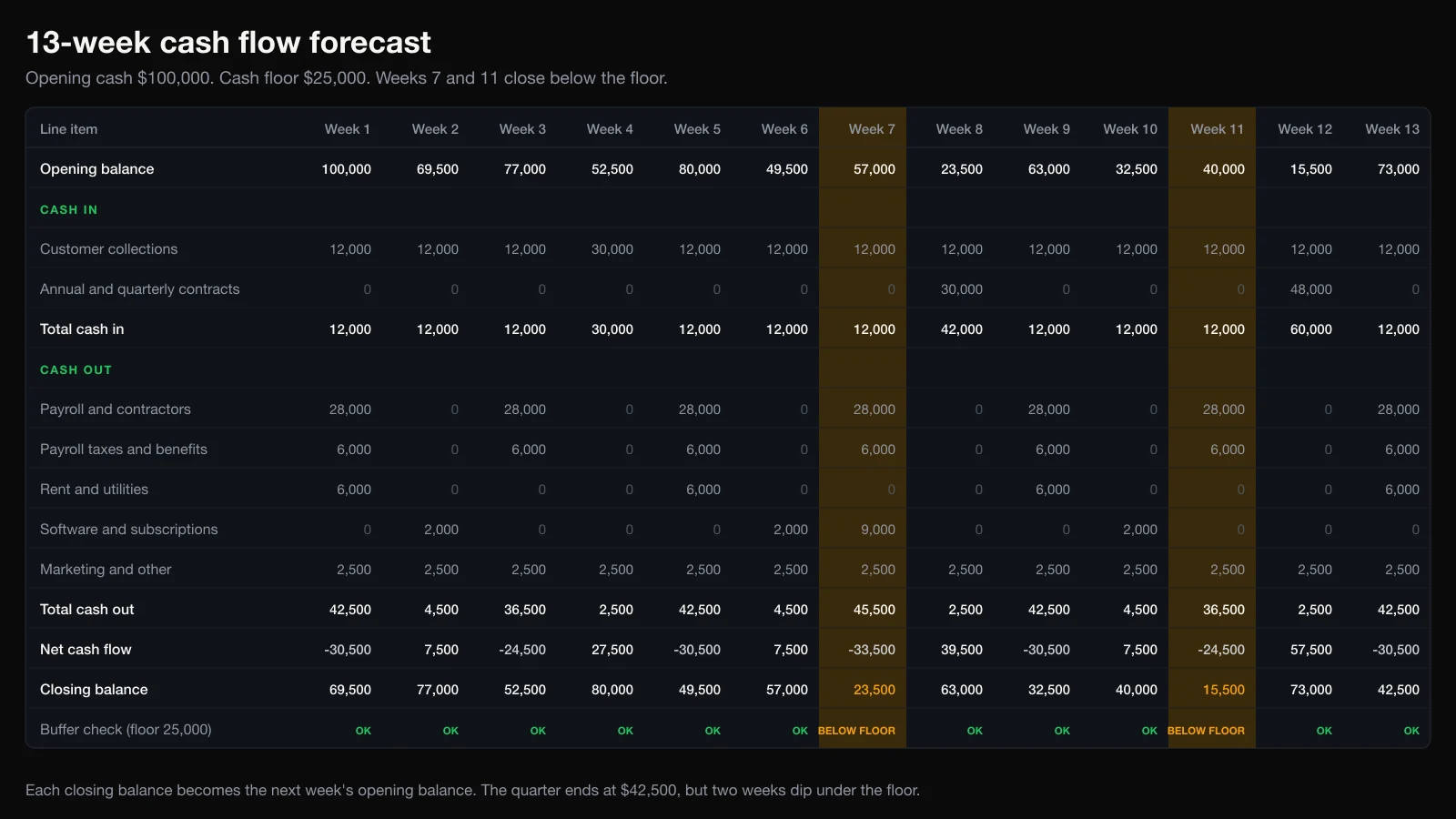
The ending balance for Week 1 becomes the opening balance for Week 2, and so on.
Keep rolling forward.
Step 6: Run Different Scenarios
Here's where most people give up: "Too complicated," they say.
But a single forecast can hide what's coming. A customer might pay late, costs might go up, revenue might fall short.
Build at least three versions:
- Base case: What you expect to happen
- Worst case: Some payments are late, some expenses are higher
- Best case: Payments come in early, revenue exceeds expectations
Track not just the ending balance but the lowest point during each scenario.
Step 7: Watch It Update
Here's the key to making this actually useful: compare it to reality.
At the end of each week, replace what you forecasted with what actually happened.
Why was a particular invoice collected late? Did a vendor overcharge you? Was the timing different than planned?
Your next forecast is smarter because you learned from Week 1's data.
Two Main Methods: Direct and Indirect
There are two primary ways to forecast cash flow, plus a third way to think about updating your forecast.
Direct Method
This is what most people should start with. You simply list individual categories of cash in and out by date.
- Invoice collections
- Payroll
- Rent
- Vendor bills
- Loan payments
- Taxes
It's particularly powerful for short-term (weekly) forecasting because it focuses on when cash actually moves.
Indirect Method
This starts with your projected profit and makes adjustments for non-cash items and balance sheet changes.
It accounts for things like:
- Depreciation (non-cash expense)
- Changes in accounts receivable
- Changes in accounts payable
- Working capital adjustments
This method is more useful for longer-term planning because it connects to your P&L and balance sheet.
I'd recommend starting with direct and moving to indirect later. The direct method is easier to understand and more accurate for short-term cash management.
Rolling Forecasts
A rolling forecast is a forecast that "rolls forward" as time passes.
Example: A 13-week rolling forecast. Every week, you remove that week's old forecast and replace it with actual results. Update your assumptions and add a new week.
This way, you're always looking at the next 13 weeks instead of re-forecasting to the end of a quarter.
A Practical Approach
Here's my advice: use a 13-week direct-method rolling forecast as your primary tool.
Most businesses need to know the next 3–4 months. The direct method makes it clear when cash moves. The rolling approach keeps it current.
Cash Flow Forecast vs. Cash Flow Statement vs. Budget
These three tools are often confused, but they serve different purposes.
| Tool | Purpose | When to Use |
|---|---|---|
| Cash flow forecast | Predict what's coming | Next 3–12 months |
| Cash flow statement | Report what happened | Last month or last year |
| Budget | Set financial targets | Year-ahead planning |
A cash flow statement tells you what did happen.
A cash flow forecast tells you what will happen.
A budget establishes what you want to happen.
You can stay within your monthly expense budget and still run out of cash because your receivables are tied up. That's why all three are useful, but none can replace a forward-looking cash forecast.
Weekly or Monthly: What's Right for Your Business?
It depends on your operations.
Weekly forecasting is more granular and catches timing issues better. If you have weekly payroll or large variable expenses, weekly forecasts are usually necessary.
Monthly forecasting is simpler and better for looking at trends over 3, 6, or 12 months.
Common sweet spot: Weekly forecasts for the next 12–16 weeks, with a monthly forecast for the next 6–12 months.
I've worked with companies doing both and having them cross-check each other. They get the best of both worlds: operational visibility and strategic planning.
Common Mistakes I See
I've seen all of these, sometimes in the same company.
Mistake #1: Treating Invoices as Cash
I know how seductive this is on paper, but please, let me try one more time: an issued invoice is not cash.
If you need to collect cash and the forecast assumes an invoice is paid on day 30 when it's actually paid on day 45, your forecast will look healthy until you're actually short on day 31.
Mistake #2: Spreading Expenses Too Evenly
This is my favorite because it's so common and so damaging.
Don't divide monthly expenses by four to spread them across weeks. Rent might be due on the 1st, payroll might be biweekly, vendor payments might be net-30.
Spread the cash timing, not the accounting expense, across your weeks.
Mistake #3: Only Looking at Month-End Balances
Here's a company I worked with: their month-end cash looked great. Until the week before they needed to pay their supplier, when they hit a cash hole.
They missed it because they only looked at the month's ending balance.
Always track your lowest projected balance during the month, not just the end.
Mistake #4: No Safety Cushion
Here's where a lot of small business owners get themselves into trouble: "If I can reach zero, that's fine, we just get paid tomorrow."
Wrong. If your minimum cash requirement is $10,000 and your forecast shows you'll have $5,000, you'll be in a hole before you think you are.
Build in a realistic operating reserve.
Mistake #5: Building a Forecast and Then Ignoring It
I've seen spreadsheets that haven't been touched in 6–9 months.
The company's actuals changed, assumptions became outdated, and the forecast was no longer useful.
Treating forecasting like a one-and-done project is what turns it into a "useless model." Make it a weekly habit.
Improving Your Accuracy
Here's the truth: no forecast is ever 100% accurate.
Cash forecasting works when you do it right. Here's my process:
1. Start With Clean Data
Make sure your bank statements are up to date. Reconcile accounts monthly. Keep your receivables and payables records current.
Garbage in means garbage out.
2. Think About How People Actually Pay
Don't just use contract terms. If your customers typically pay 2–3 weeks late, build that behavior into your forecast.
I'll tell you something counterintuitive: I've found that actual historical collection data is often more accurate than your contract terms. People's behavior is consistent even when it contradicts what they say they'll do.
3. Track Your Forecasts vs. Reality
Compare what you forecasted to what actually happened.
- Expected $25,000 from Customer A, collected $18,000. Why?
- Expected a $5,000 vendor payment on the 15th, they charged you on the 5th. Why?
Investigate these differences. Learn from them.
4. Keep Iterating
Your assumptions should improve over time. You now know that your vendor XYZ habitually overcharges by $100. You know your typical customer pays 21 days instead of the 30-day terms.
Use that knowledge in your next forecast.
It's not about having a more complex spreadsheet. It's about having better inputs.
Spreadsheets vs. Software
You don't need to hire a CFO or buy expensive software to do cash flow forecasting.
A well-maintained spreadsheet can work great for:
- Early-stage startups
- Small businesses with simpler cash timing
- Teams that haven't yet established workflows
Spreadsheet advantages:
- Flexible: You can tweak any formula
- Transparent: You can see exactly how the numbers work
- Free: No monthly subscription
When Software Makes Sense
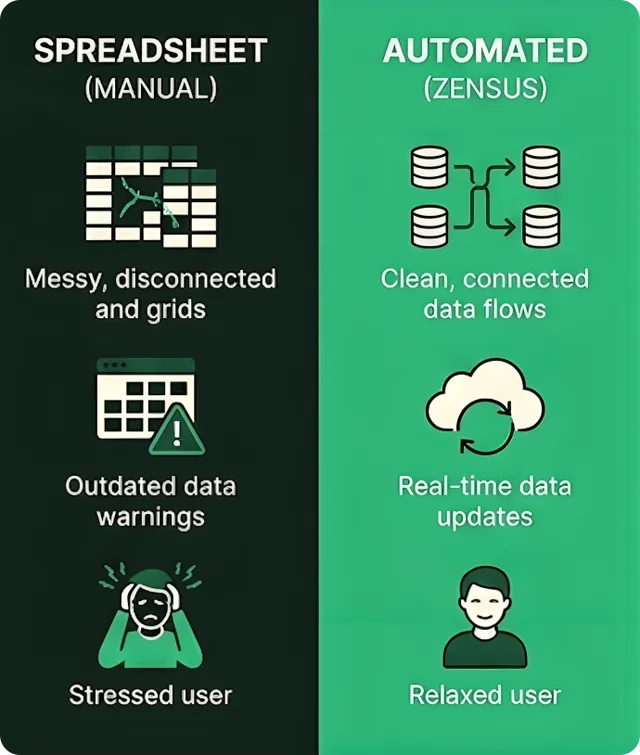
If you're scaling and hit certain pain points, software can help:
- Manual data entry is tedious: Having to copy/paste from multiple accounting platforms and bank statements
- You need real-time updates: Your forecast isn't getting updated weekly
- Complex scenarios: Testing multiple "what-if" situations becomes difficult
- You're losing track: Your team's forecasts become stale
Good cash flow software will:
- Pull from your accounting or banking systems
- Automatically update as transactions post
- Let you compare scenarios easily
- Highlight when cash drops below your threshold
- Show forecasts vs. actuals
My Advice
Start with a spreadsheet. Build the process first.
If you find yourself:
- Spending more time maintaining the forecast than learning from it
- Complaining about how often you need to update it
- Losing track of where your forecasts are
Then consider software.
The goal isn't "buying software." The goal is freeing yourself to focus on the decisions, not the mechanics.
Here's the Real Payoff
Let me tell you what cash flow forecasting gave our startup:
We had $21,000 in the bank at month-end. By the time our CFO said, "We should probably pull back on that hiring plan," the weekly forecast already showed us dropping to $1,000 in Week 2, $9,000 below our safety line.
We wouldn't have known that without a weekly forecast.
We used that forecast to:
- Negotiate better payment terms with a major supplier
- Shift $10,000 from reserves to cover payroll in the tight week
- Table the equipment purchase by 3 months
- Secure a short-term line of credit before the cash crunch
That one month of better planning saved us from a potentially disastrous scramble at month-end.
The Bottom Line
Cash flow forecasting isn't about predicting the future.
It's about making sure you don't have a cash surprise at payroll time.
It's about knowing when you can afford to say yes, and when you need to slow down.
It's about having enough cash at every critical moment, not just at month-end.
If you're building a cash flow forecast, spend time making it:
- Timely: update weekly, not quarterly
- Detailed: look at weekly balances, not just month-end
- Responsive: adjust assumptions based on what actually happens
The most important number you can know isn't your month-end cash balance.
It's the lowest cash balance you'll hit during any week before you take action.
Because having $21,000 in the bank at month-end while you hit a $9,000 shortfall in Week 2?
That's a month-end surprise that your business probably can't afford.
This post is part of a series on building cash flow visibility. Read the next post: What Is a 13-Week Cash Flow Forecast?
Related guides:
- What is a 13-week cash flow forecast?: the rolling weekly model most businesses use.
- Predictive cash flow forecasting: dating receipts by how customers actually pay.
- Cash flow early warning system: turning your lowest week into an alert.
- Will I make payroll?: checking every payroll date against your cash.