Here's a question that keeps most founders up at night:
When will you run out of cash?
You might have 12 months of runway. You're growing revenue. Investors love your traction. But unless you calculate and understand the answer to this one question, you're flying blind:
Will your company become profitable before it runs out of cash?
This is where things get real. Y Combinator co-founder Paul Graham wrote about this back in 2015: what he called default alive versus default dead.
But here's what most people don't realize: Graham was really asking you to project your cash, not just worry about the next round. And that's where I think his framework is still the best tool founders have today.
The math is straightforward, but the human part matters most. Because knowing whether you're default alive or default dead changes everything you do next: with hiring, spending, your product, and when you start thinking about raising money.
A founder who knows their numbers can make deliberate choices. A founder who doesn't? Well, they'll usually figure it out the day they can't figure it out anymore.
In the sections below, I'm going to walk you through:
- How to calculate whether your startup is default alive or default dead
- A real checklist you can actually use
- Why your "runway" number might be lying to you
- What to do if the answer is "default dead"
- How Zensus can help you model your cash trajectory
This isn't just theory. This is a survival guide.
What Does "Default Alive" vs. "Default Dead" Actually Mean?
Here's the simple version:
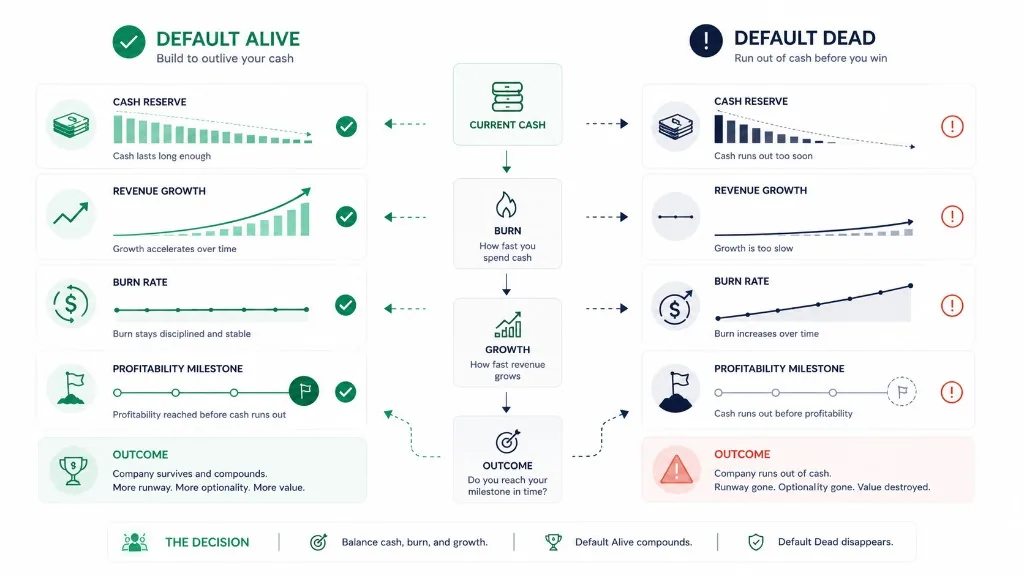
You're default alive when, at today's growth rate and spending, you're on track to reach profitability before you run out of cash. You don't need new money for this to work: your business does.
You're default dead when, at today's trajectory, you'll run out of cash before you hit profitability. Your current path requires outside capital or a change in direction.
Both are forecasts, not fate.
Paul Graham's original essay explains this brilliantly. But most people miss the point.
A default alive startup can still be burning cash today. Default dead doesn't mean you're bankrupt. It means the numbers say you need to change course before it's too late.
Here's a quick comparison:
| Question | Default Alive | Default Dead |
|---|---|---|
| Will your current trajectory lead to profitability before cash runs out? | Yes | No |
| Does your base case require raising money to survive? | Not unless conditions worsen | Yes, or you need to change course |
| Is your company profitable today? | Probably not | Probably not |
| What should you do next? | Protect the runway, invest carefully | Change the trajectory: cut costs, improve collections, or start fundraising |
| Can either status change? | Yes | Yes, absolutely |
Default dead is a signal, not a death sentence.
The whole point is that you know there's time to do something different while you still have options.
The Four Inputs You Need
You don't need a fancy financial model. Paul Graham's original test asked a simple question: if your revenue grows and expenses stay flat, will you get to profitability before your cash runs out?
That's four numbers.
1. Available cash
How much cash can you actually spend right now?
Include money that's available across your operating accounts. But leave out restricted cash, invoices you haven't collected, uncommitted financing, and any funds you can't or won't be able to legally spend.
Example: $300,000
That's your runway. Your buffer. Your margin for error.
2. Current monthly revenue
How much money is coming into the business month over month?
Here's where people trip up: don't confuse annual recurring revenue (ARR) with actual cash collections.
If you're a SaaS company and close a $120,000 annual contract, that's $10,000 a month on paper. But depending on when that payment comes in and how many times a year customers renew, your actual cash timing could be very different.
For our working example, we'll assume:
Monthly revenue: $50,000
3. Recent monthly revenue growth
How fast has revenue actually been growing?
Don't use your best month. Use several months to get a representative picture. If you grew from $40,000 to $50,000 over four months, your compound monthly growth rate is:
Monthly growth = (50,000 ÷ 40,000)1/4 − 1 ≈ 5.7%
Think of growth as an assumption, not a promise. Test different scenarios: what if growth slows to 3%? What if a key customer churns? What if collections lag?
4. Monthly operating expenses
How much does it cost to run the business?
Payroll, software, infrastructure, contractors, rent, marketing: put it all in. For a more accurate picture, also include taxes, debt payments, and planned hires with their actual payment dates.
Example: $90,000
With these four numbers, you can project when you'll break even, and whether you'll survive until then.
How to Calculate: Your Default Alive or Default Dead Status
This isn't a simple ratio. It's a forward-looking cash projection.
You're looking for two dates:
- When revenue covers expenses (break-even)
- When your cash runs out
If the break-even date comes first → Default alive
If the cash runs out first → Default dead
Step 1: Project monthly revenue
Assuming your growth rate holds steady, your revenue in month m would be:
Revenuem = Current revenue × (1 + growth rate)m−1
Month 1 is next month. If you start at $50,000 and grow 10% monthly, you get $55,000 in month 2, then $60,500 in month 3, and so on.
Step 2: Project expenses
In Graham's simplified version, expenses stay flat. But in the real world, they don't. New hires? Their salaries. Contract renewals? Their costs. Growth might mean higher marketing or sales commissions.
Use consistent time periods and assumptions for both revenue and expenses.
Step 3: Calculate monthly cash flow
If you're a cash-based business (collections happen in the month the sale closes):
Monthly net cash flow = Cash receipts − Cash payments
Ending cash = Starting cash + Monthly net cash flow
When receipts are lower than expenses, cash drains. When receipts beat expenses, cash grows. Repeat for each month in your cash flow forecast.
Step 4: Find your break-even month
When does recurring revenue finally cover your operating expenses?
In our example, that's month 8 when revenue hits around $90,000.
Important: Accounting profit ≠ cash availability. Taxes, working capital changes, and financing payments all mess with the timing.
Step 5: Find the first cash shortfall
This is where most people go wrong. Don't just check the ending balance.
A company might have cash through month 8, but what if they need to pay a $150,000 vendor bill on the 15th, but a key customer doesn't pay until the 25th?
They're "fine" at month-end, but they can't actually pay the bill.
Use weekly or daily cash dates for accuracy. Model the timing of real payments and receipts.
Step 6: Compare
If break-even comes before the first cash shortfall → default alive
If cash runs out before break-even → default dead
And here's the kicker: When your forecast is close to the boundary, don't assume you're safe. Test conservative scenarios. What if growth slows? What if collections lag?
Worked Example: Growth Makes All the Difference
Let's imagine a SaaS startup with these numbers:
| Input | Amount |
|---|---|
| Opening cash | $300,000 |
| Monthly revenue | $50,000 |
| Monthly expenses | $90,000 |
| Net burn rate | $40,000 |
| New funding in forecast | $0 |
Assumptions: Revenue is collected the same month you recognize it. Expenses stay flat. No taxes. No one-time costs.
Scenario A: 10% monthly growth
Revenue grows fast enough to cover expenses.
| Month | Revenue | Expenses | Ending Cash |
|---|---|---|---|
| 1 | $50,000 | $90,000 | $260,000 |
| 4 | $66,550 | $90,000 | $172,050 |
| 8 | $97,436 | $90,000 | $151,794 |
You hit break-even in month 8 with $152,000 cash left in the bank.
Verdict: Default alive.
Notice: You're not a "high growth" company by most definitions. But your trajectory works.
Scenario B: 3% monthly growth
Same company, slower growth.
| Month | Revenue | Expenses | Ending Cash |
|---|---|---|---|
| 1 | $50,000 | $90,000 | $260,000 |
| 4 | $54,636 | $90,000 | $149,181 |
| 8 | $61,494 | $90,000 | $24,617 |
| 9 | $63,339 | $90,000 | −$2,045 |
Revenue doesn't reach $90,000/month until month 21. But you're in the red in month 9.
Verdict: Default dead.
What changed? Nothing about your starting cash, expenses, or current revenue. Just a 7-point difference in the assumed growth rate.
But that single assumption change flips your entire financial outlook.
| Metric | Scenario A (10% growth) | Scenario B (3% growth) |
|---|---|---|
| Monthly growth rate | 10% | 3% |
| First break-even | Month 8 | Month 21 |
| First cash shortfall | None in forecast | Month 9 |
| Default status | Alive | Dead |
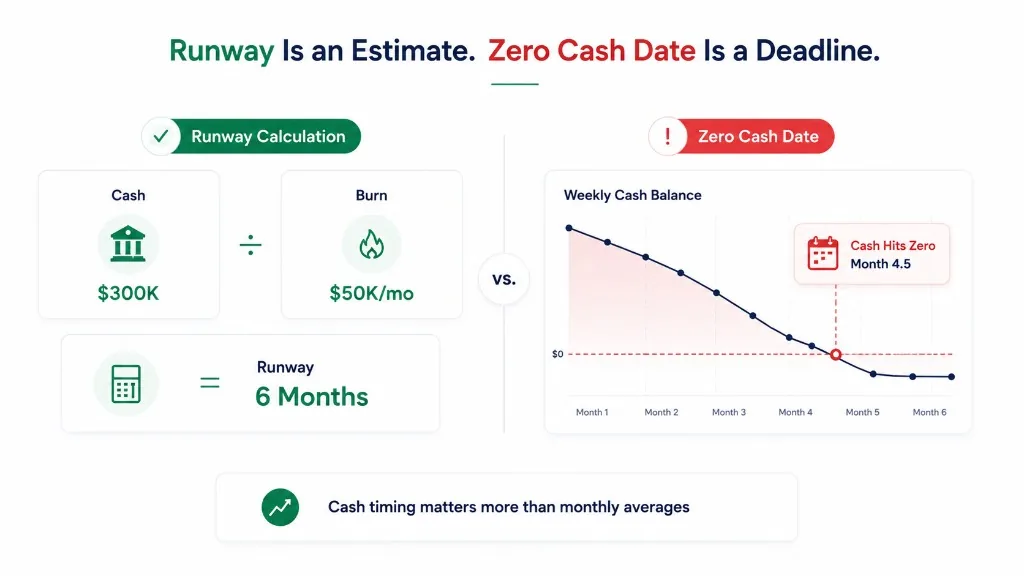
This is why your "7.5 months of runway" number doesn't actually tell you what you need to know.
Runway answers: How long until we run out if nothing changes? Default alive answers: Can we reach profitability before running out?
One is about the status quo. The other is about possibility.
The Founder's Default Alive Checklist
Use this checklist in three situations:
- During your monthly financial review
- Before making a major hiring decision
- When investors ask whether your company is "fundable"
- 1. Verify your available cash. Reconcile balances. Exclude restricted cash, uncleared deposits, and anything you can't actually spend.
- 2. Validate your revenue. Separate recognized revenue from actual cash collected. Factor in unpaid invoices and any irregular customers.
- 3. Calculate realized growth. Use recent representative months. Factor in churn, seasonality, and concentrate on recurring business, not one-off deals.
- 4. Forecast expenses. Payroll, vendors, software, rent, marketing, and committed hiring. For accuracy, model payment dates.
- 5. Find break-even. When will recurring revenue cover operating expenses? Distinguish accounting profit from cash flow.
- 6. Find first shortfall. Project cash through break-even and note the first negative balance. Watch the minimum cash balance along the way, not just the ending number.
- 7. Stress-test. What if growth slows? What if collections lag? What if a key customer churns? How does the forecast change?
- 8. Write a no-fundraise Plan B. What would you do if investors don't move? Who owns the changes? What's the last date you can delay?
- 9. Recalculate monthly. And again whenever something changes: new hire, big win, lost customer, changed terms, financing decision.
Three questions that matter most
Once you've run through the checklist, ask yourself:
When do we become profitable?
When could we first run short of cash?
What's the last safe date to change our plan?
If you can't answer all three, stop. Your forecast needs work before you make real decisions.
Why Your "Runway" Number Might Be Misleading
Founders know their runway. They'll say, "We have 12 months of runway."
But that number often tells you more about how you calculated it than what it actually means.
Runway assumes the burn rate stays the same
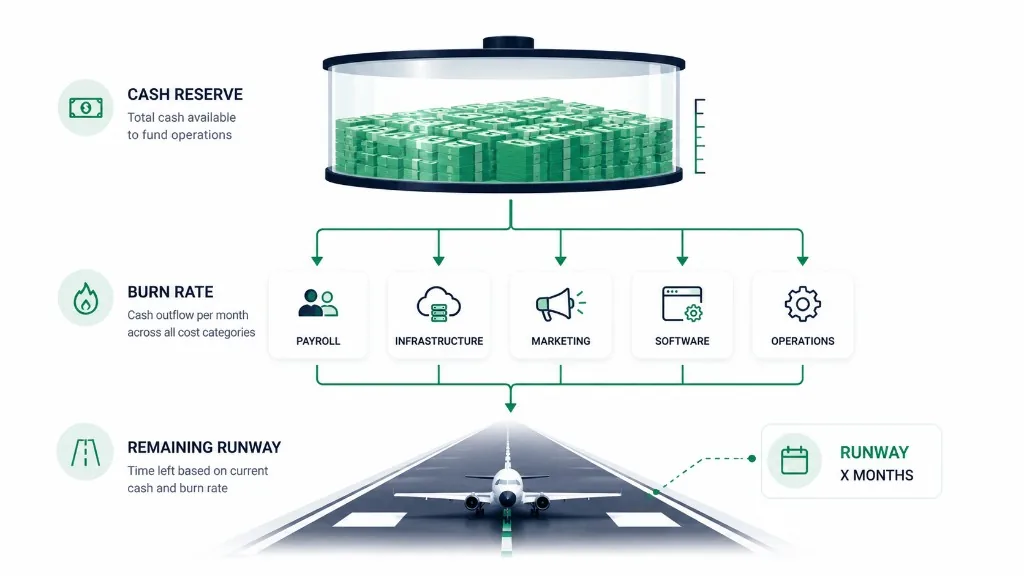
Runway = Available cash / Monthly net burn
In our example: $300,000 / $40,000 = 7.5 months.
But that assumes nothing changes. And things will change. If revenue grows and expenses stay flat, your net burn drops. You might reach profitability with months to spare.
Runway measures your cash at today's burn. It's backward-looking.
Burn multiple measures growth efficiency, not survival
David Sacks introduced burn multiple to measure capital efficiency:
Burn multiple = Net burn during a period / Net new ARR in that period
If you burned $600,000 in Q1 and added $300,000 in net new ARR, your burn multiple is 2.0x. You spent two dollars of cash to add one dollar of growth.
Lower is better when you're growing. If your new ARR is zero, the metric breaks down.
But here's what I think gets missed:
Burn multiple doesn't tell you when you'll survive. It tells you how efficiently you're burning.
A company can have a 1.5x burn multiple and still be default dead if growth is too slow to reach profitability in time. A company can be default alive even with a 3x burn multiple if they're close to profitability.
Runway measures cash duration. Burn multiple measures capital efficiency. Default alive measures whether your business can survive on its own trajectory.
You need all three numbers to make sense.
The Cash Timing Problem: Your "Safe" Month Hides a Crisis
I've seen this play out too many times.
A startup comes to me saying, "Our month-end cash balance is positive. We're fine."
Here's what I found:
They started the month with $20,000. They expected $60,000 in customer payments. They had $50,000 in payroll coming up.
Month-end projection: $20,000 + $60,000 − $50,000 = $30,000. "We're good."
Reality: The payroll is due on the 15th. The customer payment comes on the 25th.
| Date | What happens | Cash balance |
|---|---|---|
| Month 1st | Start with $20,000 | $20,000 |
| 15th | Payroll due | −$30,000 |
| 25th | Customer payment | $30,000 |
They couldn't make payroll on the 15th. They would have gone to collections or needed a loan before the 15th.
Monthly averages hide cash problems that are actually about timing.
This is why you need a 13-week cash flow forecast. It shows you what's coming up in the next 90 days. And if you're really stressed, go weekly and model actual payment dates.
The goal isn't "what's the month-end balance." It's "what's the lowest point I hit and when?"
What To Do If The Answer Is "Default Dead"
Here's the hard truth: finding out you're default dead sucks.
But the earlier you know it, the more time you have to do something about it.
Your goal isn't to make your runway number look better. Your goal is to change your trajectory.
1. Cut spending that isn't essential
Look at every recurring expense. Is this software actually used? Does this contractor deliver value? Will this marketing spend actually generate customers? What about planned hiring that's justified by future revenue that might never materialize?
There's a difference between costs that keep the engine running and costs that the engine hopes to carry.
2. Fix your cash collection
You can improve cash availability without changing sales.
Look at: How quickly do customers pay? What's our overdue balance? Are we getting paid upfront or net-30/60/90?
For subscription businesses: is growth coming in collected cash or just reported ARR? I've seen startups get carried away by top-line ARR numbers only to discover half of it doesn't actually convert to cash.
3. Reduce expenses to meet the new reality
Going back to our example: cut expenses from $90,000 to $70,000 and 3% growth now gets you to break-even by month 13.
Cost cuts alone won't solve every problem, but they can fundamentally shift the math in your favor.
4. Treat fundraising as a choice, not a guarantee
If you're default dead, you need to start thinking about raising money. But here's what I wish more people understood:
- A SAFE that hasn't been signed isn't money
- A bridge round that depends on "getting a larger round" isn't secured capital
- A loan that depends on a certain balance sheet isn't accessible capital
Build two forecasts:
Base case (no new money): Your current trajectory. Know when you hit bottom.
Funded scenario: Realistic timing and amount of capital. Know what it costs and what new obligations you're taking on.
Decide how many months you can operate in the base case before activating the funded scenario.
5. Set a decision deadline
You might be able to delay changes, but don't delay the decision.
If your cash runs out in eight weeks, you need to know now what you're committing to. Work backward from your threshold and your obligations.
The "Fatal Pinch": A Silent Trap
Paul Graham had a name for this: the fatal pinch.
It's three conditions combined:
Default dead + slow growth + no time to fix it.
I've watched companies sit for months, convinced the next fundraise will save them. The cash drains. Growth stutters. And then, suddenly, they can't get money anymore.
The market, investors, even your own traction: they've changed.
By the time the numbers finally look bad, it's often too late. The options for fixing things have disappeared.
This is why checking your default-alive status early matters. You're not predicting doom. You're buying time to make choices.
How Often Should You Re-run This?
Monthly. At minimum.
And whenever something changes:
- New hire or major spending commitment
- Big customer win or unexpected churn
- Growth accelerates or stalls
- Payment terms or collections change
- You make a financing decision
- A significant change in infrastructure or operating costs
The longer-term "when will we be profitable" projection and the 13-week "what's coming next" forecast serve different purposes.
Long-term projection: Can we become sustainable?
Short-term forecast: Can we survive the next 90 days?
When liquidity is tight, review your 13-week forecast weekly. Stress the scenarios. What if we lose our two biggest customers? What if growth slows to zero?
How Zensus Can Help
Okay, here's where I'm going to be honest.
You can absolutely do this in Excel. Many founders do. The framework is simple enough.
But as soon as you factor in the reality of how money actually moves (payments arrive on day 15, not day 30, and day 25), as soon as you have payroll dates, tax deadlines, bank holidays, and customers who split payments across months, the model gets fragile.
That's where tools designed for this become useful.
Zensus helps you build forward-looking cash models with the complexity that actually matters:
- Actual payment and receipt dates
- A scenario with adjustable assumptions
- What-if testing for hiring, churn, pricing, and one-off costs
- Your scenario compared against your baseline
You don't have to trust "end of month averages." You can see the actual cash trajectory week by week.
Example questions Zensus can help you answer:
- What happens to our cash if revenue growth slows by 5%?
- How does adding one senior engineer change our projected burn?
- What if we lose our biggest customer?
- What does a one-off $50,000 cost next quarter do to our cash?
That's the difference between knowing your runway number and actually understanding your financial survival.
A note on terminology: Zensus offers a runway calculator, which is a useful tool for estimating cash duration. It's not a "default alive calculator," which would require a more complex forward revenue-expense projection. The tools do different things.
The Bottom Line
Know your trajectory before you need to change it.
Being default alive doesn't mean you're guaranteed to succeed. Being default dead doesn't mean you're destined to fail.
But knowing gives you control.
Before your next board meeting, your next raise, your next hiring decision, ask:
When do we become profitable?
Will our cash last until then?
What's our Plan B if the answer to either is no?
Answer those questions honestly. And remember: the worst thing you can do is wait to discover the answer when you have no options left.
Sources & Further Reading:
- Paul Graham: Default Alive or Default Dead? (2015)
- Y Combinator: How Not to Fail (2016)
- David Sacks: The Burn Multiple (2020)
Related guides:
- Runway vs burn rate: the formulas behind both numbers.
- Zero cash date: finding the date your cash actually runs out.
- What is a 13-week cash flow forecast?: the short-term view of the next 90 days.
- ARR vs cash: why reported ARR and collected cash disagree.