Your startup may show six months of runway on paper, but still not have enough cash to make payroll next month.
It's not that you have less money. It's that timing is everything. Money doesn't enter and leave your bank account at a neat, even monthly rate. A big invoice might arrive two weeks after you needed to pay a vendor. A customer payment might clear four weeks late. Payroll always falls on a specific day.
Your zero cash date is the first point when your projected available cash hits zero, assuming receipts and payments happen on the schedule you expect. A weekly cash forecast can tell you which week is at risk. To pinpoint a specific day, you need clear dates for individual transactions.
This distinction matters when your biggest customer pays after you've already made payroll, or when a tax bill arrives before an annual renewal payment. In these cases, a healthy-looking monthly average can completely hide a dangerous shortfall happening in the middle of the month.
What Is a Zero Cash Date?
A zero cash date (sometimes called a cash-out date or cash zero date) is the first moment in your cash projection when available operating cash reaches zero or below. It answers the scary question founders ask themselves: "When will my startup run out of cash if things go according to plan?"
For real risk management, you should track three separate points:
| What to track | Why it matters |
|---|---|
| First zero-or-below balance | When projected cash hits $0 or less |
| First negative balance | When you need to spend what you don't have: a model shortfall (banks may reject this) |
| First cash-floor breach | When cash drops below the minimum you need to keep operations running |
Important: These are forecasts, not crystal balls. When customers pay sooner or later than expected, when you hire or cut costs, or when a vendor payment gets delayed, that date changes. But knowing your first projected risk point is still invaluable.
Zero Cash Date vs. Cash Runway: Why It Matters
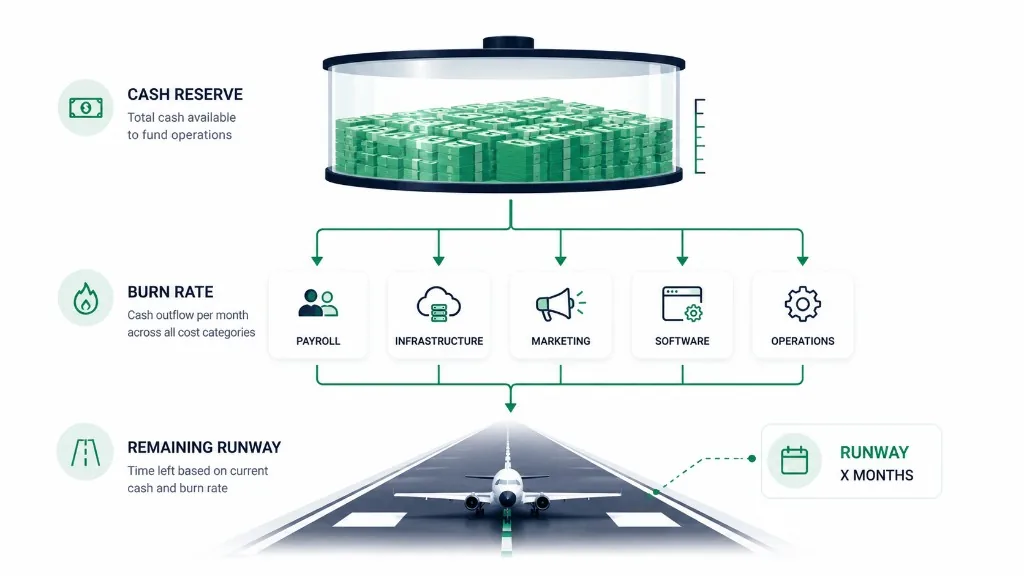
Cash runway (like you get from a basic runway calculator) is typically a duration: "We have 6 months."
Zero cash date is a calendar point: "We'll hit zero on approximately December 15."
They answer fundamentally different questions.
| Question | Monthly runway | Zero cash date |
|---|---|---|
| What does it tell you? | Roughly how many months cash lasts at average burn | Exactly which week (or day) cash hits your threshold |
| Typical calculation | Available cash ÷ monthly net burn | Roll forward cash after real scheduled receipts and payments |
| Best for | High-level strategic planning | Making this week's payroll decision |
| Main limitation | Smooths out dangerous timing gaps | Requires a detailed, dated cash schedule |
The runway formula:
Cash runway (months) = Available cash ÷ Average monthly net burn
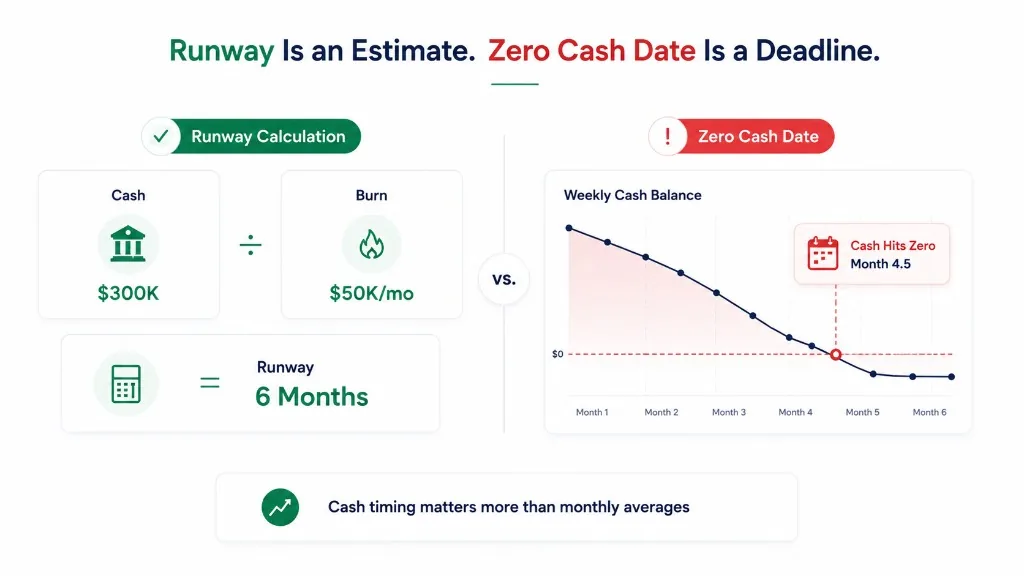
So if you have $300,000 in the bank and your company burns $50,000 more than it collects each month, the simple math says:
$300,000 ÷ $50,000 = 6 months of runway
That feels reassuring, right? But here's the catch: $300,000 ÷ $50,000 assumes your cash flows are evenly distributed.
In reality, your payroll might hit on the 15th, while a key client's payment doesn't clear until the 25th. Those 10 days matter. So do month-end taxes, annual software renewals, and equipment purchases that hit at specific times.
As Mercury explains in their burn rate guide, relying on constant-burn assumptions can overstate your actual runway, especially when expenses are rising.
If your average net burn is zero or negative (profitable!), this simple division stops being meaningful. You still need to plan your cash timing though.
How to Calculate Your Zero Cash Date (Step by Step)
Good news: You don't need expensive software to build a first version. A simple spreadsheet with a starting balance and dated cash movements can show you the dangerous timing problems you're facing.
Step 1: Start With Reconciled Cash
Pick an explicit starting date: last Friday's bank balance, for example. Make sure you're counting available, unrestricted cash that you can actually spend on operations.
Important: Don't count money that's:
- Locked in a different bank account
- Restricted by board resolutions
- From financing that hasn't closed yet
Step 2: Forecast Receipts on Clear Dates
List your expected incoming cash: confirmed invoices, recurring subscriptions, renewal payments.
Crucial: Use the date you expect the money to actually clear, not the invoice date, not the "due by" date. If you send a $50,000 invoice today, when do you realistically expect to get paid? Net-30? Net-45?
Separate:
- Confirmed receipts (you've invoiced and they're due)
- Likely receipts (it's in the pipeline based on what's been promised)
- Speculative/funding (uncommitted capital raises, potential payments from leads)
Don't assume the future in your survival planning.
Step 3: Schedule Payments on Clear Dates
Payroll, payroll taxes, rent, loan payments, vendor bills, annual renewals, big purchases: put these on a calendar with actual cash-clearing dates.
This is where most founders get tripped up. A $30,000 monthly payroll (paid as $15,000 each on the 15th and 30th) should not be smoothed into a $1,000 daily expense just because it helps you find a zero-crossing date.
You're not trying to find when your company goes bankrupt. You're trying to find out if you can make payroll next Monday.
Step 4: Roll Forward Week by Week
For each week:
Closing cash = Opening cash + Cash that cleared in − Cash that cleared out
Take last week's ending balance and make it this week's starting balance.
For dates where you have large transactions on the same day:
Cash after event = Cash before event + Inflows that cleared − Outflows that cleared
If you're not sure which transaction clears first on a given day, write down your assumption. A Friday-ending balance might show you're positive, but if you have payroll on the 30th and a $50,000 invoice clears on the 31st, you needed that money the day before, or you had to draw a bridge.
Step 5: Find the First Crossing Point
Scan your rolling forecast for:
- The first week where cash is ≤ $0 (or < $0, if you're tracking negative balance)
- The first breach of your cash floor
- The lowest balance in the entire model, and when it happens
If everything looks fine through your forecast horizon, you might say: "No zero crossing within this forecast window." This is more honest than claiming "infinite runway."
Your zero cash date is that first week (or specific day, if you have dated transactions) where cash hits your threshold.
Worked Example: Six Months on Paper, A Shortfall by Week 20
Let's say you have $300,000 in the bank and are burning through $50,000 per month on average.
Simple math: 6 months of runway.
Now let's look at a more granular, dated cash flow scenario with the same numbers.
Cash timing in this example:
- payroll of $30,000 every two weeks
- rent, software, and contractors of about $4,000 a week
- an annual software and insurance prepayment of $36,000 in week 1
- customer collections of about $5,000 a week
- a $100,000 annual customer renewal paid to you in week 22
| Week | Opening cash | Cash in | Cash out | Ending cash |
|---|---|---|---|---|
| 1 | $300,000 | $5,000 | $40,000 | $265,000 |
| 2 | $265,000 | $5,000 | $34,000 | $236,000 |
| 3 | $236,000 | $5,000 | $4,000 | $237,000 |
| 4 | $237,000 | $5,000 | $34,000 | $208,000 |
| 5 | $208,000 | $5,000 | $4,000 | $209,000 |
| 6 | $209,000 | $5,000 | $34,000 | $180,000 |
| 7 | $180,000 | $5,000 | $4,000 | $181,000 |
| 8 | $181,000 | $5,000 | $34,000 | $152,000 |
| 9 | $152,000 | $5,000 | $4,000 | $153,000 |
| 10 | $153,000 | $5,000 | $34,000 | $124,000 |
| 11 | $124,000 | $5,000 | $4,000 | $125,000 |
| 12 | $125,000 | $5,000 | $34,000 | $96,000 |
| 13 | $96,000 | $5,000 | $4,000 | $97,000 |
| 14 | $97,000 | $5,000 | $34,000 | $68,000 |
| 15 | $68,000 | $5,000 | $4,000 | $69,000 |
| 16 | $69,000 | $5,000 | $34,000 | $40,000 |
| 17 | $40,000 | $5,000 | $4,000 | $41,000 |
| 18 | $41,000 | $5,000 | $34,000 | $12,000 |
| 19 | $12,000 | $5,000 | $4,000 | $13,000 |
| 20 | $13,000 | $5,000 | $34,000 | -$16,000 |
| 21 | -$16,000 | $5,000 | $4,000 | -$15,000 |
| 22 | -$15,000 | $105,000 | $34,000 | $56,000 |
When you roll this forward, you might find that by week 20, your cash balance first hits zero, 4.5 months out, not the full 6 months you thought.
Why? Because the week 20 payroll lands two weeks before that $100,000 customer renewal arrives in week 22. Those two weeks of negative balance could be deadly. Over six months, the average burn really is $50,000; the timing is what moves the zero forward.
This is the central insight: Your first projected shortfall can arrive well before your "6-month runway" estimate suggests.
But here's the nuance: A week-20 zero is a forecast, not a prophecy. If your biggest customer pays that renewal two weeks early, cash stays above zero until week 26, the six months the average promised. If it pays two weeks late, the shortfall lasts until week 24.
For a smaller, simpler example that's easy to reproduce:
Imagine $50,000 in starting cash, no other activity:
| Date | Cash event | Effect | Cash after |
|---|---|---|---|
| Before Nov 2, 2026 | Opening balance | $50,000 | |
| Nov 2, 2026 | Payroll | -$40,000 | $10,000 |
| Nov 4, 2026 | Vendor payment | -$25,000 | -$15,000 |
| Nov 6, 2026 | Customer payment | +$35,000 | $20,000 |
What does this mean?
The first negative balance is November 4, even though you end the week with $20,000.
On November 2, you had enough for payroll but not the vendor payment. You paid them anyway in the model (showing a -$15,000 shortfall), expecting the customer to cover it later. On November 6, that customer finally sent the money, and you're positive again.
This is the key lesson: A positive end-of-week balance does not mean you were able to make all payments on time. You still had a critical cash gap that required a bridge, a rescheduled payment, or an early collection to resolve.
Why a Positive Month-End Balance Can Still Hide a Payroll Shortfall
Monthly financial reports love to answer:
"How much cash did we have at month-end?"
Good for investors. If they know you had $50,000 at month-end, they're relieved.
Not useful if you're making payroll. You don't get to decide when month-end hits. You get to decide if there's enough money when payroll clears.
Consider this November example:
- Nov 1: Start with $50,000
- Nov 15 (payroll): Pay $55,000 → -$5,000 remaining
- Nov 30 (big client): Receive $60,000 → $55,000 month-end
Month-end looks great: $55,000, up from $50,000!
But wait: payroll on Nov 15 needed $5,000 you didn't have, and the jump from -$5,000 to $55,000 depends on the client paying on Nov 30. What if the client is going to pay on Dec 1st, not Nov 30th?
This is why weekly forecasting helps: It narrows the scope and makes dangerous timing gaps visible.
But when you have large transactions clustered in the same week, you need to go daily. A week-ending balance can miss the worst days entirely.
Set a Cash Floor: Don't Just Watch for Zero
Here's a thought that should give founders pause.
Your business can be in serious trouble even if its balance never hits zero.
Every company has minimum cash they need to operate safely:
- Enough for one or two payroll cycles
- Enough to cover critical vendor bills
- A buffer for unexpected delays
In the Nov 2 to Nov 6 example above, suppose your policy is to keep at least $30,000 in the account.
Looking at that example:
- Before Nov 2: $50,000
- Nov 2: After payroll, $10,000 → This is your first cash-floor breach
Your company technically still has "positive cash" ($10,000 > $0), but it's below what you need to keep running. If the next payroll is two weeks away, $10,000 will not cover it.
Your first cash-floor breach (Nov 2) comes 2 days before your first zero-or-below point (Nov 4).
That 2-day warning matters. It's the difference between:
- Calling the VC Tuesday to ask for a bridge
- Realizing on Nov 4 that the vendor payment was already unpayable
Document your floor clearly. Is it a fixed policy amount? Or does it change based on upcoming commitments? Don't double-count money as both "required" and "optional."
What Changes Your Zero Cash Date?
Your forecast is only as good as the assumptions behind it. Test scenarios that stress your timeline:
| Scenario | How to test it | What you learn |
|---|---|---|
| Late collections | Delay your top 5 invoices by 14 and 28 days | Will it create a shortfall earlier? |
| Payroll timing | Add a new hire starting next week | How much earlier does the dip arrive? |
| Tax season | Include estimated tax payment date | Does this push the zero-crossing? |
| Annual renewals | Schedule equipment/insurance contracts | Where's the cash cliff? |
| Contract prepayments | Move a $100k advance up or down 2 weeks | Critical timing shift |
| Financing | Add a round closing on a specific date | Does this save the month? |
| Contracted payments | Remove an annual customer contract | What's the impact on runway? |
When you run these scenarios, don't just look at total month-end cash. Track:
- First cash-floor breach (your early warning)
- First zero or negative point
- Lowest balance in the entire horizon
These three numbers tell you more than "ending balance."
How Accurate Is a Zero Cash Date Forecast?
Honest answer: You're making estimates based on assumptions. Some inputs you know (today's bank balance, cleared transactions). Most are guesses (when will that customer pay? When will we close the next round?).
Your forecast precision depends on your data detail:
| Approach | What it can show |
|---|---|
| Monthly average burn | Rough runway length, interpolated date |
| Weekly cash schedule | Which week is at risk |
| Dated daily transactions | Specific day of first shortfall |
A weekly model alone can't reliably give you an exact day. If week 3 shows a positive ending balance, you still don't know if there's a gap on Tuesday of week 3 that gets covered before Thursday.
For exact day-level precision, you need:
- Individual transaction dates
- Clear understanding of cash inflow/outflow order
- A day-by-day rolling calculation
The 13-Week Window
A practical rule: Use a rolling 13-week cash flow forecast for near-term decisions. Every week:
- Update past weeks with what actually happened
- Add a new week so you always see 13 weeks ahead
- Recheck zero/cash-floor crossing points
If your forecasted cash-out date is beyond 13 weeks, you still have a forecast, but it's less certain. You need to extend the horizon or focus on the 13-week window for tactical decisions.
As Float's guide to 13-week forecasting explains, this rolling approach keeps your forward view current without getting overwhelmed by the distant future.
How to Monitor Your Cash Out Date Every Week
Make this a non-negotiable weekly ritual. Here's a seven-step cash-timing audit:
- Reconcile opening cash: Verify your starting balance against current bank statements. Exclude restricted funds.
- Update collections: Forecast when money will clear, not when you think it's due.
- Label receipt confidence: Mark each inflow as confirmed, likely, or speculative.
- Check obligations: Payroll dates, taxes, rent, loan payments, vendor bills, all on the calendar.
- Add one-offs: Annual renewals, equipment purchases, contract prepayments. Don't forget the lumps.
- Find the crossings: First floor breach, first zero/negative, lowest point. Track critical days inside each week.
- Roll actuals: Update last week with what really happened, compare forecast vs. actuals, and look for timing vs. amount variance.
Actionable insight: If you can't track the timing variance, you're flying blind. Assign someone on your team to update the forecast weekly.
When a cash-floor breach shows up:
- What action do you need to take? (Raise capital, delay a payment, get a line of credit?)
- What's the last practical day to act?
Calculate Your First Estimate With a Runway Calculator
If you want a quick starting point, use the Zensus startup runway calculator.
Plug in your current cash, monthly revenue, and expenses. It'll give you a cash runway estimate and a rough zero-cash date projection.
Important caveat: This calculator uses monthly assumptions and interpolates day-level dates. It's great for getting a first-order estimate, but it doesn't model actual transaction timing.
If your cash is lumpy (big invoices coming at different times, payroll on specific days), you'll want more detail:
- Use the 13-week cash flow template to map out actual weeks
- Check specific transaction dates
- Run scenarios for key changes
Zensus's product capabilities go beyond the calculator:
- Connected bank and accounting data
- Weekly cash forecasts from actuals
- Scenario modeling (what if we hire, or lose a customer?)
- Cash-floor threshold monitoring
Use the calculator as a fast approximation, then move to a 13-week model when you need real decision-making precision.
What a Zero Cash Date Forecast Is (And Isn't)
What it is:
- A conditional estimate based on current assumptions
- A tool to identify the first cash decision you might be unable to make
- A way to spot dangerous timing gaps before they become crises
What it isn't:
- A guaranteed prediction (customer payments change, plans shift)
- An incentive to delay action (don't wait for zero; act on floor breaches)
- A replacement for ongoing operational cash management
The goal is simple: Find the first cash decision you can't afford, not because you haven't checked in enough, but because the timing of events caught you off guard.
Next Steps
You now have the tools to find your zero cash date. But here's what I'd recommend:
- Use the runway calculator first to get a quick baseline
- Build a weekly cash flow model (I've included a template you can use)
- Identify your cash floor based on your obligations
- Find your first cash-floor breach: that's where you start worrying
- Test key scenarios (late payments, new hires, delayed renewals)
- Update this forecast weekly and roll in actuals
This is a refresh of an original June 2026 post by Ashwin Menon.
Related guides:
- Runway vs burn rate: the monthly runway math this guide builds on.
- Will I make payroll?: checking each payroll date against your cash.
- Cash flow early warning system: setting a cash floor and alerts.
- What is a 13-week cash flow forecast?: the rolling weekly model.