I'll tell you something nobody puts in their investor decks:
ARR and cash are not the same thing.
Don't roll your eyes. Hear me out.
When you're scaling a SaaS business, you want to hear that your Annual Recurring Revenue is growing. Nothing sounds better than seeing that number climb from $100K to $500K to $2M. Your investors are nodding and smiling. Your pitch deck charts look killer.
But then you check your bank account.
And it's not moving.
Maybe it's flat. Maybe it's bleeding out faster than it should be.
You've got a growing pipeline, a solid retention rate, maybe even strong net revenue retention... and yet when it comes time to pay the team, cover expenses, or just survive the next quarter, the money isn't there.
This is not a fantasy. This is the daily reality for most SaaS founders I've worked with.
Why ARR Doesn't Predict Your Next Payroll
Let's break down why this happens.
ARR (Annual Recurring Revenue) measures the annualized value of your active subscriptions at a point in time. Your bank balance reflects money actually collected, minus money actually spent.
These are three different measurements:
- ARR: how much recurring subscription value your active customers represent on an annualized basis
- Cash flow: money moving into and out of your business over time
- Bank balance: what's actually sitting in your account right now
A $120,000 subscription can increase ARR by $120,000 without generating $120,000 of immediate cash. And understanding why matters, because this difference determines whether you can make payroll next month.
The Five Metrics You're Probably Confusing
Most founders think they know what ARR means. But when I break this down for them, they realize their metric definitions are way off.
Here's the reality:
| Metric | What it actually measures | When it changes |
|---|---|---|
| ARR | Annualized recurring subscription value | When active subscription value changes under your reporting policy |
| Billings | Amount invoiced to customers | When invoices are issued |
| Cash collections | Customer payments actually received | When payments settle |
| Recognized revenue | Revenue earned as services are delivered | As services are fulfilled under accounting rules |
| Bank cash | Cash held in bank accounts | As cleared inflows and outflows change the balance |
A sixth metric, bookings, records customer commitments before they're active or invoiced. Like ARR, it's a non-GAAP metric, and it varies by company.
A sale does not necessarily mean an invoice. An invoice does not necessarily mean payment. And payment does not necessarily mean the company has earned all the revenue.
These metrics are connected, but they're not interchangeable. And when you mix them up, your financial decisions become dangerous.
Follow One $120,000 Contract From Promise to Payday
I want to show you exactly what happens to a SaaS contract, from the moment it's signed to when the revenue is actually recognized.
Imagine your company signs a customer for a one-year subscription:
- Annual price: $120,000
- Service period: January 1 through December 31
- Billing: Annual, upfront
- Invoice date: January 1
- Payment date: January 1
The service gets delivered evenly over 12 months. No surprises: no discounts, no credits, no early churning, no taxes or fees for this example.
Here's the journey:
Step 1: ARR Increases by $120,000
On January 1, when the subscription becomes active, you add $120,000 to your ARR. Your MRR (monthly recurring revenue) equivalent is $10,000.
But hear me here: This doesn't mean $120,000 will be deposited every month. It's the annualized value of that active subscription. It's a point-in-time metric.
Step 2: You Issue a $120,000 Invoice
Same day. January 1. The customer receives an invoice for the full annual amount.
This isn't cash yet. This is a bill. An invoice is not a bank deposit.
Step 3: The Customer Pays $120,000
The payment settles on January 1. The money appears in your bank account.
That's when the cash movement actually happens. January cash collections: $120,000.
Now, you've committed to providing software access for 12 months. The cash has arrived. Twelve months of service still remain.
Step 4: Revenue Is Recognized Over Time
This is where accounting gets real. Under standard accounting rules, you recognize revenue as services are delivered, not when money arrives.
If the service is delivered evenly, you recognize $10,000 per month ($120,000 ÷ 12).
By the end of January, you've recognized $10,000 in revenue. The remaining $110,000 becomes deferred revenue: it's money you've collected but haven't earned yet.
Step 5: The Full Picture
Here's what that same $120,000 contract looks like across the year:
| Metric | January | February | December |
|---|---|---|---|
| Active ARR | $120,000 | $120,000 | $120,000 |
| New invoices | $120,000 | $0 | $0 |
| Cash collected | $120,000 | $0 | $0 |
| Revenue recognized | $10,000 | $10,000 | $10,000 |
| Ending deferred revenue | $110,000 | $100,000 | $0 |
See the pattern?
First, ARR stays constant. Once the contract is active, it stays on the books until the end. It doesn't add $120,000 every month. That would be wrong.
Second, cash arrives all at once. No payment arrives from this contract after January.
Third, revenue keeps flowing even without payments. That's the core of subscription accounting.
But here's what none of this tells you: What's left in the bank at the end of the month, after payroll and expenses?
To answer that question, you need to think about outflows, not just inflows.
Why ARR Can Grow While Your Bank Balance Crumbles
Let's flip the script.
Same customer. Same $120,000 annual contract. But now they're billed monthly, not upfront.
The subscription becomes active on January 1, so ARR jumps by $120,000. You invoice $10,000 that month. But the customer doesn't pay until... well, not this month.
Meanwhile, your business is running. Payroll. Infrastructure. Vendors. All consuming cash.
Monthly cash reconciliation:
| Item | Amount |
|---|---|
| Opening bank cash | $200,000 |
| Cash from new subscription | $0 (customer didn't pay) |
| Collections from existing customers | +$30,000 |
| Payroll, hosting, vendors paid | −$55,000 |
| Ending bank cash | $175,000 |
What happened here?
- You added $120,000 in ARR
- Your bank cash decreased by $25,000
The math is simple: $200,000 + $0 + $30,000 − $55,000 = $175,000.
Nothing is wrong with your ARR. The new customer is a real, paying customer eventually. They'll probably pay later, or renew. The contract has value.
The problem: The ARR increase hasn't turned into cash receipts yet. Meanwhile, you've been burning cash to keep the business running.
This is why founders ask: "We added $500K in ARR this quarter. Why is our bank account not growing?"
And this is why I always remind them: "How much ARR did we add" is not the same question as "Can we make payroll next week?"
The Five Dates That Control Your Cash Reality
When you think about SaaS contracts, there are five key dates you need to track. I don't know how many of you actually do this, but you should:
- Subscription activation: When does this contract start contributing to active ARR?
- Invoice issuance: When does the customer get billed?
- Payment settlement: When does the money actually land in your bank?
- Revenue recognition: When does the company recognize this as earned revenue?
- Expense payments: When does the company need to pay payroll and vendors?
Your contract signing date is often a sixth event that happens before the first one.
When these dates don't line up, ARR and cash can move in opposite directions.
A customer might sign in January, start service in February, get an invoice in March, and pay in April.
If your forecasting tool treats all these events as happening on the same day, it's not telling you the truth about your liquidity.
Annual Billing vs Monthly Billing: The Cash Timing Game
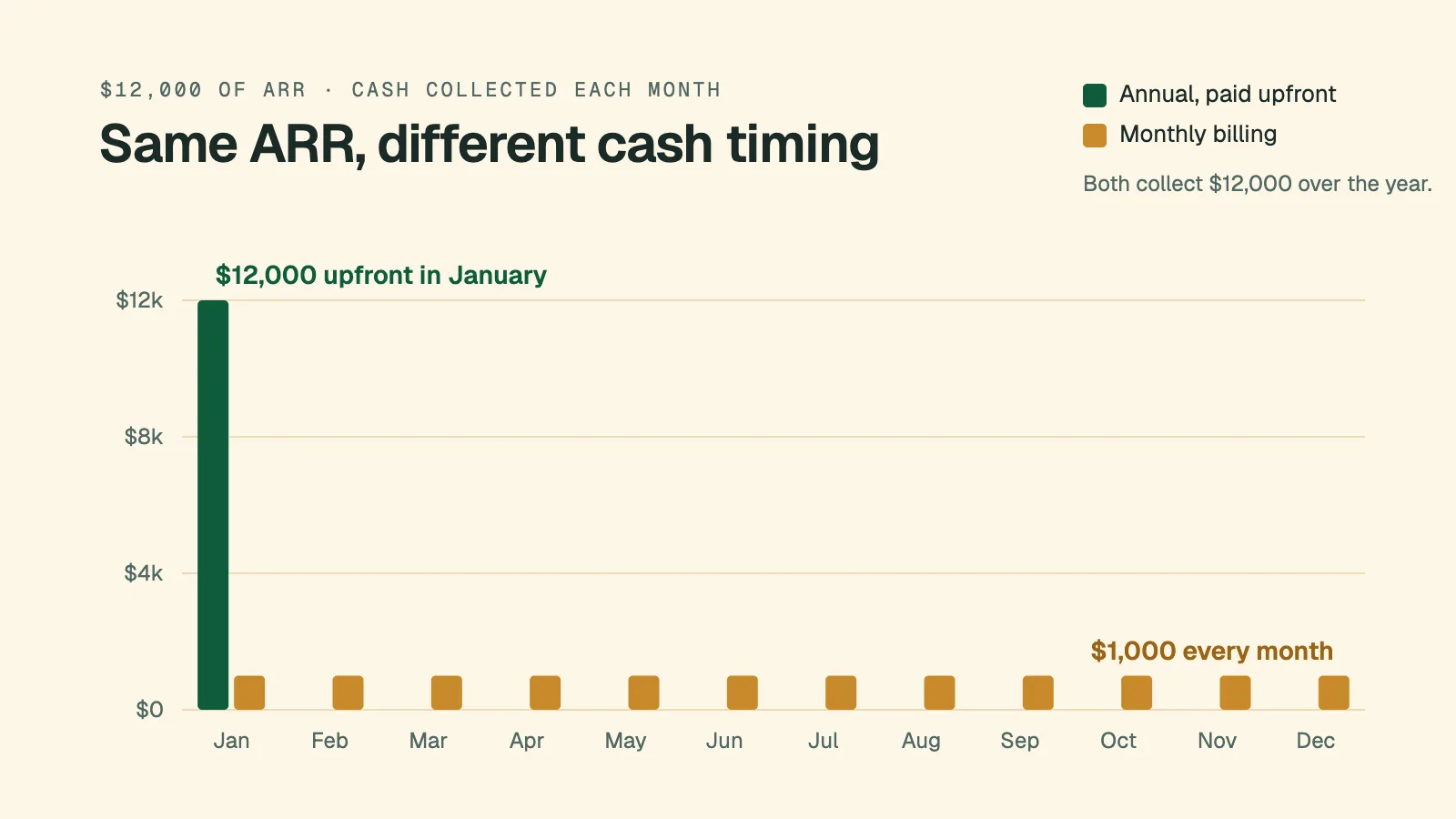
Let's compare two customers. Same product. Same price: $12,000 per year.
Customer A pays annually upfront. Customer B pays monthly.
Here's their cash timing over the year:
| Month | Annual upfront cash | Monthly cash |
|---|---|---|
| January | $12,000 | $1,000 |
| February | $0 | $1,000 |
| March | $0 | $1,000 |
| April | $0 | $1,000 |
| May | $0 | $1,000 |
| June | $0 | $1,000 |
| July | $0 | $1,000 |
| August | $0 | $1,000 |
| September | $0 | $1,000 |
| October | $0 | $1,000 |
| November | $0 | $1,000 |
| December | $0 | $1,000 |
Both subscriptions have the same total cash over the year. Both represent $12,000 in ARR.
But their cash timing is completely different.
Annual billing upfront? You get that cash right now. That can help you cover payroll, pay for the engineers building the new feature, or just breathe easier this quarter.
Monthly billing? You get money spread across 12 months. Smaller, steady streams. Less risk of hitting a cliff if one payment bounces.
So which is better?
For cash timing in the near term? Annual billing usually wins. You have more cash available to work with early in the contract.
But annual billing doesn't automatically:
- Increase your ARR (if both customers are on equivalent plans)
- Improve your profitability (costs are the same)
- Eliminate churn or renewal risk
- Extend your runway past the contract year
A company relying heavily on annual renewals might have a fat cash balance right now. But when that payment is due again, what if the customer churns? What if they go bankrupt? What if the renewal gets delayed?
Annual prepayment accelerates cash collection. It doesn't create magic money.
It changes when you have it, not how much you'll ever make.
What Does Deferred Revenue Actually Mean?
Every founder knows what "deferred revenue" sounds like in investor deck language. The reality is messier.
Deferred revenue (or contract liability in accounting terms) happens when you've collected (or are already owed) cash you haven't earned yet.
Let's say a customer pays $120,000 upfront for a year of service. You record a cash inflow. But you also have an obligation: you still need to deliver that service over the remaining months.
In accounting terms, this creates a contract liability. As you deliver the service month by month, you reduce the liability and recognize revenue.
Here's the part no one tells you:
An unpaid invoice that's already due can also create deferred revenue.
Imagine a customer who agrees to pay $50,000 in November for a service they'll receive in December. You send the invoice in November, but they don't pay until... they don't pay until next year.
Until you deliver December's service, you have a contract liability. You have no cash, but you have a deferred revenue obligation.
Deferred revenue represents future service you owe. It is not cash available to spend.
Why Two $1M ARR Companies Can Have Different Runway
Let me set up a scenario.
Company A: 100 customers on $10,000 annual contracts. They pay upfront.
Company B: Also 100 customers, same $10,000 annual contracts. They pay monthly.
Both have $1 million ARR.
Let's assume their monthly cash expenses are identical: $120,000 per month for payroll, hosting, and everything else.
Early in the year:
- Company A has a lot more cash. Their renewals just hit.
- Company B is collecting slowly. Cash is tight.
Six months later:
- Company A's initial wave is done. No more customer cash arrives until renewal, and its balance falls $120,000 every month.
- Company B's monthly collections cover part of its costs, so its balance falls more slowly. But it never had the early cushion.
Bottom line: The timing of when payments arrive creates dramatically different cash positions.
And it's not just about who has more ARR at the end of the year. It's about when they need the cash.
A company might finish a month with $100,000 in the bank, but need $150,000 by Thursday for payroll and rent.
A monthly revenue dashboard doesn't tell you that.
A dated cash flow forecast does.
Here's How to Actually Forecast Your Cash
Forget about "How much ARR will we add next quarter?" and ask yourself:
"What's our cash balance going to look like in 13 weeks, and what could break it?"
Here's a practical approach that works for real founders:
Step 1: Start With What's Actually in the Bank
Pull your latest bank statement. Get the reconciled balance. Separate what you can actually spend now from what's pending or restricted.
This is your starting point. Not ARR. Not projected revenue. The cash you have today.
Step 2: Map When Customers Actually Pay
For each meaningful customer, note these dates:
| Field | What it is |
|---|---|
| Next invoice amount | How much are they billed this cycle? |
| Invoice date | When was the bill sent? |
| Payment due date | When must they pay? |
| Expected settlement date | When will the money land in your account? |
Track expected settlement date, not invoice date.
Your customer with Net-30 terms doesn't always pay in 30 days. Maybe they pay in 42 days. Maybe they pay late, or don't pay at all.
Use your payment history. Update it as new information arrives.
Step 3: Don't Forget Outflows
Forecast when you'll pay:
- Payroll and contractor payments
- Cloud infrastructure bills
- Software vendors
- Taxes and obligations
- Rent and operating costs
- Debt payments
- Customer refunds or credits
If your cash flow forecast only includes incoming cash and ignores expenses, it's lying to you.
Step 4: Build the Weekly Bridge
Calculate week by week:
Ending cash = Beginning cash + Inflows − Outflows
Here's a sketch of what that looks like:
| Week | Beginning cash | Inflows | Outflows | Ending cash |
|---|---|---|---|---|
| 1 | $200,000 | $10,000 | $25,000 | $185,000 |
| 2 | $185,000 | $15,000 | $35,000 | $165,000 |
| 3 | $165,000 | $5,000 | $40,000 | $130,000 |
| 4 | $130,000 | $30,000 | $20,000 | $140,000 |
The company starts with $200,000 and ends week 4 with $140,000.
But Week 3 is where you should be nervous. Cash dips to $130,000.
If most of that week's $40,000 goes out on Monday and the $5,000 collection doesn't land until Friday, Monday is the real low point, not the week-end balance.
A week's balance doesn't tell you about daily cash needs.
Step 5: Stress-Test the Forecast
What if:
- Your largest customer pays 30 days late?
- A $250,000 enterprise renewal slips into the next quarter?
- Three mid-market customers downgrade?
- Payroll goes up 15% due to hiring?
- That enterprise contract never activates?
Adjust one variable at a time. Recalculate. See how the minimum cash balance shifts.
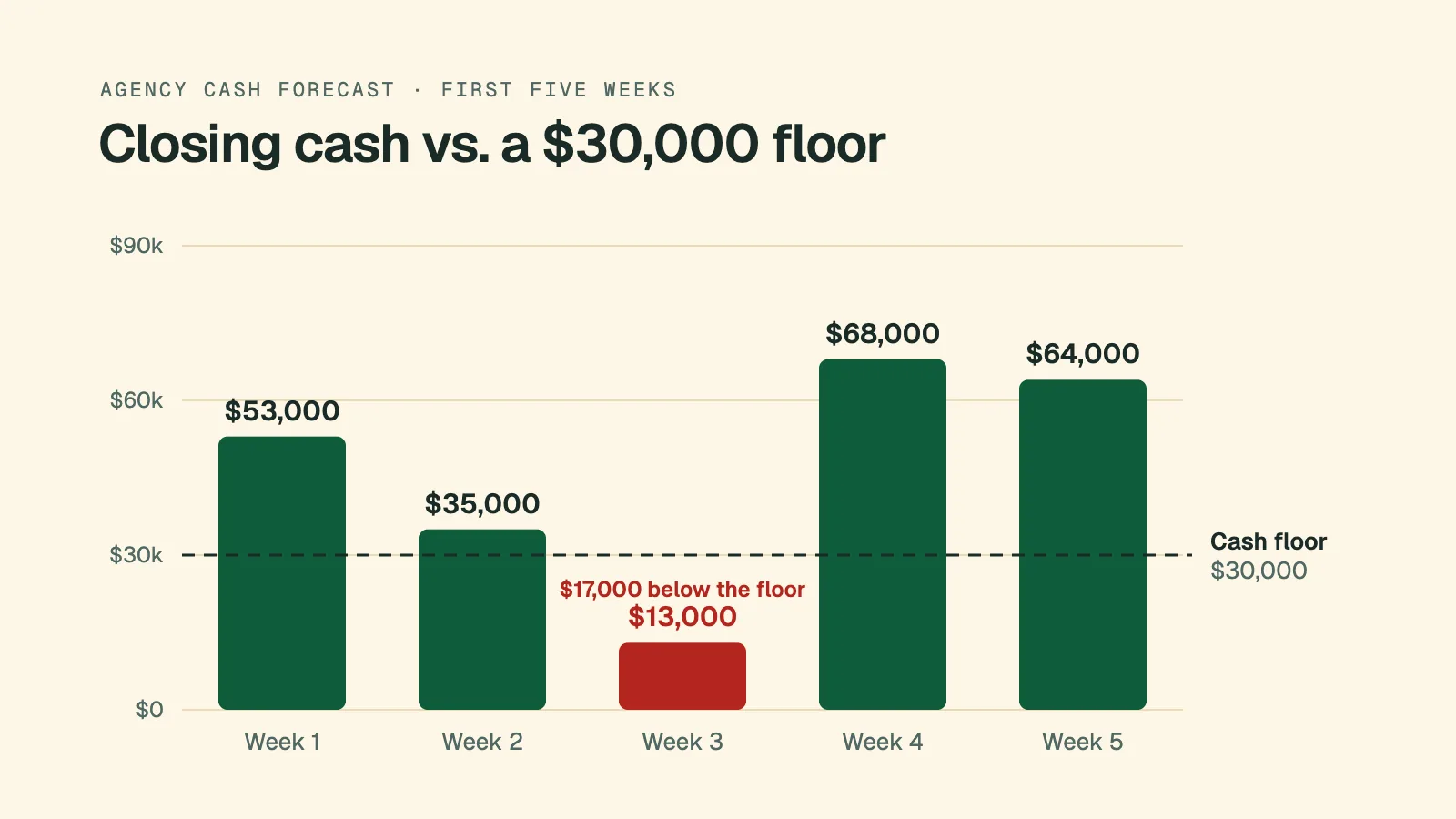
Compare the result against your cash floor: whatever cash you absolutely need to keep operating.
That's how you answer: When will we run out of cash?
The Founder's Diagnostic: ARR Is Up, So Why Isn't Cash?
Let's say ARR grew this month, but your bank balance went down. Here's what to check:
- Are those new contracts actually active? Or are they future-start bookings that shouldn't count yet?
- Have you invoiced all your active customers? Any billing configuration gaps?
- How much has been invoiced but remains unpaid? (Accounts Receivable)
- Are payments 30, 60, 90 days overdue?
- Are your annual renewals due next quarter?
- Have customers started payments that haven't cleared yet?
- Have you issued credits or processed refunds?
- Is your payroll, vendor spending, or taxes growing faster than collections?
- Are you missing key outflows in your accounting?
- Do your bank statement, payment processor, and accounting books match on dates?
Don't look for a magic explanation. Look for where in the sequence is the break.
Subscription → Invoice → Payment → Bank cash → Operating expenses
Each event has an amount and a date. Once you map them all, the gap between ARR growth and cash flow becomes obvious.
What Metrics Should You Actually Watch Together?
ARR is important. It tells you the scale of your recurring business.
But it doesn't tell the whole story.
Here's what a practical founder dashboard should include:
| Metric | What question does it answer? |
|---|---|
| ARR | What's our current annualized recurring subscription value? |
| Net revenue retention | Are our existing customers growing or shrinking? |
| Billings | How much have we invoiced this period? |
| Accounts receivable | How much customer money is still owed to us? |
| Days sales outstanding | How long on average is it taking to collect? |
| Cash collections | How much cash did customers actually pay us? |
| Deferred revenue | How much service do we still owe on collected cash? |
| Bank cash | How much cash do we have in our accounts right now? |
| Net cash burn | How fast are we using cash? |
| Minimum forecast cash | How low could our cash go before we recover? |
For a SaaS company with hundreds of subscriptions, these metrics tell a richer story than ARR alone.
What Zensus Does (And What It Doesn't)
Founders don't need another dashboard that tells them "ARR is growing, by the way."
They need to know:
If things go as expected, what cash will we have next month?
What happens if we lose a key customer?
When exactly will we need more cash?
That's what Zensus helps with.
Zensus is a cash flow forecasting platform. It takes your subscription data, your billing data, your bank transactions, and builds a rolling forecast of what's coming in and going out.
It helps founders and finance operators connect their financial information and answer questions like:
- When is that renewal payment due to hit our bank?
- Can we make payroll on the 15th?
- When would we run out of cash if we lose our biggest customer?
- How much additional operating cash do we need before the next big inflow?
What it doesn't do: learn each customer's payment habits. Zensus places open invoices and renewals on their due dates and moves overdue invoices two weeks out, so a customer who always pays late still needs your judgment.
We're not replacing ARR. We're adding the missing piece: timing.
Because in SaaS, it's not about how much recurring revenue you'll make this year. It's about whether you can afford to wait six months for that revenue to arrive.
The Bottom Line
ARR and cash are not enemies. They're different metrics answering different questions.
- ARR tells you how big your recurring business is growing.
- Cash flow tells you whether you're spending more than you're collecting.
- Bank balance shows what you have right now.
Your bank account can stay flat even as ARR grows, because new contracts take time to convert into payments. Your balance can drop even as ARR climbs, because expenses eat through collections faster than payments arrive.
A company can collect $120,000 upfront and have plenty of cash for now, but burn through it all in two months. Or it can add $120,000 in ARR while collecting nothing from the new customer that month.
The question isn't "Is our ARR growing?"
The question should be: "When will we have the cash to pay the bill?"
ARR tells you how much recurring business you've built. A dated cash flow forecast tells you whether you can afford the decisions you're about to make.
And when the gap gets too big?
That's when it's time to forecast, not just hope.
Founders, your investors may want to see ARR growth. Your team needs cash next month.
Don't let ARR be a distraction from your cash reality.
Forecast it. Manage it. Survive it.