A founder's guide to calculating burn rate, understanding startup runway, and identifying cash shortages before they become emergencies.
Let's start with the basics, because I wish someone had sat down with me and explained this a few years ago.
You know your burn rate. Probably inside and out. You can tell someone how much runway your startup has on any given day.
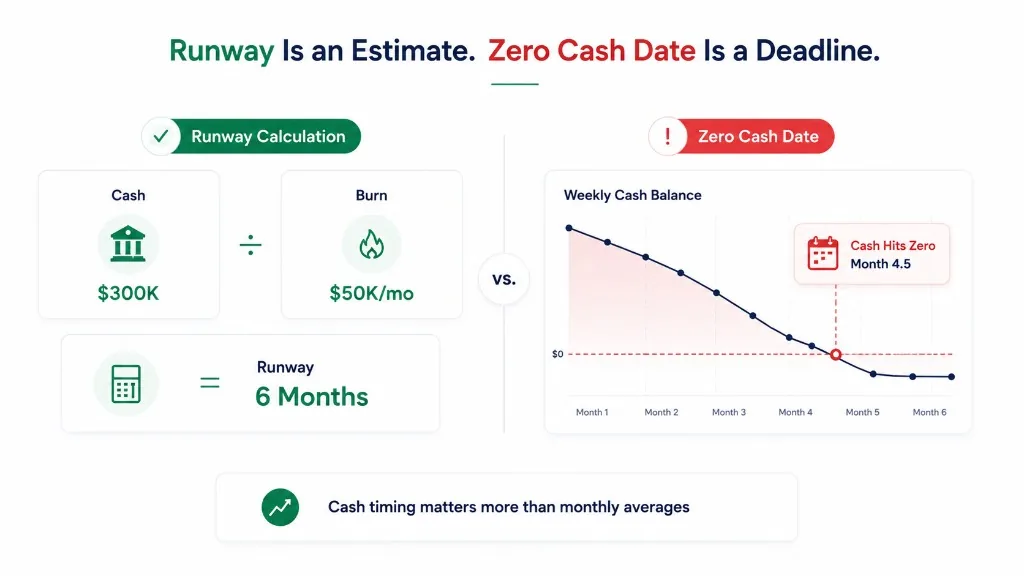
But here's what nobody in your board meetings or investor calls explained to you: knowing both numbers doesn't mean you know when you'll actually run out of cash.
I remember staring at our bank balance after a particularly tough month, thinking "we're fine, we have X months of runway." Meanwhile, payroll was due in two weeks and I was already drafting an emergency fundraising pitch in my head.
The reality is that both burn rate and runway are useful metrics, but they answer different questions, and neither one tells you when a payment might fail.
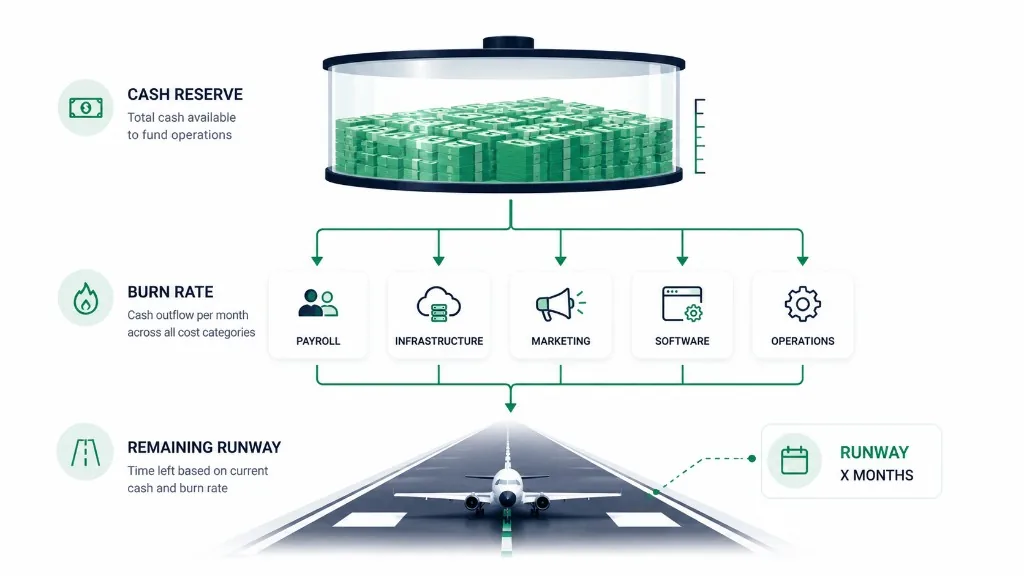
Burn rate measures how quickly your startup consumes cash, usually in dollars per month. Runway estimates how many months your business could keep operating if your cash and burn rate stayed constant.
For example, a startup with $600,000 in available cash and a monthly net burn of $50,000 has an estimated runway of twelve months.
But that calculation assumes spending and collections stay perfectly consistent, which is exactly why you shouldn't rely on it alone.
Let me walk you through how these metrics work together, how to calculate them properly, and why founders in 2026 need to look beyond monthly averages when making financial decisions.
Burn Rate vs. Runway: The Difference in One Example
Think of burn rate as the speed at which your startup consumes cash.
Think of runway as how long that cash can keep you running at that speed.
Let's make this concrete with an example.
Imagine your startup starts with:
- $1,200,000 in the bank (available cash)
- $150,000 in monthly operating expenses (cash going out)
- $50,000 in monthly customer payments received (cash coming in)
Your monthly net burn is:
$150,000 − $50,000 = $100,000
And your estimated runway is:
$1,200,000 ÷ $100,000 = 12 months
That's the classic textbook relationship: burn rate tells you how fast you're spending, runway tells you how long your cash will last at that pace.
Now imagine you hire two senior engineers. Your monthly expenses jump to $175,000 while customer collections stay at $50,000.
Your net burn becomes:
$175,000 − $50,000 = $125,000
Your runway drops to:
$1,200,000 ÷ $125,000 = 9.6 months
That's a $25,000 increase in monthly spending that wiped out 2.4 months of runway.
That's the tradeoff. You're trading time for growth. That's a decision you need to be comfortable making.
The five measurements founders should understand
| Metric | What it measures | Typical unit | Why you need to know it |
|---|---|---|---|
| Gross burn | Total cash going out for operations | $/month | What spending commitments do you actually have? |
| Net burn | Outflows minus customer cash collections | $/month | How quickly is operating cash actually being depleted? |
| Runway | Months until cash runs out at current burn | Months | When do you need to act? |
| Burn multiple | Net burn vs. new ARR in the same period | x | How efficiently is your growth using capital? |
| First projected cash shortfall | First date cash dips below your floor (or zero) | Calendar date | When MUST you take action? |
These answer five different questions. And the last one (when you'll actually run out of cash) is probably the one that keeps you up at night.
Because will the money actually be there when the next payment is due?
That question is what matters most when you're hiring, growing, and taking on larger financial commitments.
What Is Startup Burn Rate?
Burn rate is how much cash your startup consumes over a specified period.
Most founders calculate it monthly: expenses like salaries, software, infrastructure, and rent tend to follow a monthly cycle, and your bank statements show monthly.
But there are actually two versions that people talk about, and they're easy to confuse.
Gross Burn Rate
Gross burn is all the cash going out to run your business, before considering any customer payments.
It's the cash outflow on its own.
Formula: Gross Burn = Total Operating Cash Outflows
For example, if your monthly expenses break down like this:
| Expense | Monthly cash outflow |
|---|---|
| Payroll and benefits | $65,000 |
| Cloud infrastructure | $10,000 |
| Marketing | $8,000 |
| Software subscriptions | $4,000 |
| Rent and operations | $3,000 |
| Total gross burn | $90,000 |
Your gross burn is $90,000 per month.
When does this matter?
- You want to understand what you're actually spending on a monthly basis
- You're thinking about cutting costs or reducing headcount
- You want to know what happens if revenue suddenly stops
If your business stopped collecting revenue tomorrow, your gross burn tells you how much would still leave your bank account.
That's why it's particularly useful for expense planning, contract reviews, and preparing for tough times.
Net Burn Rate
Net burn accounts for cash you actually receive from customers during the same period.
Formula: Net Operating Burn = Operating Cash Outflows − Operating Cash Inflows
Using our same numbers:
- Monthly operating outflows: $90,000
- Customer cash collections: $40,000
Your net burn is:
$90,000 − $40,000 = $50,000 per month
You're consuming $50,000 of cash from your reserves each month.
This is what most people use for runway calculations.
Important: Revenue is NOT the Same as Cash
This is where most founders trip up.
You cannot simply subtract "revenue" from "expenses." Here's why.
Imagine your SaaS company booked $80,000 in revenue in a given month, but your bank account only shows $45,000 in cash collections.
If your expenses are $100,000, your operating net burn is:
$100,000 − $45,000 = $55,000
Not $20,000.
Here's what's happening behind the scenes:
- You invoiced customers for $80,000 in a month
- They paid $45,000 of that in the same month
- The remaining $35,000 is still unpaid and will arrive in a future month
Or perhaps you're selling an annual subscription and customers pay upfront, but revenue is recognized over the year.
Your cash movement and your accounting revenue are out of sync.
When you're calculating burn, use actual cash inflows from customers. Don't try to force it to match the P&L.
Want to dig deeper into why ARR and cash can diverge this dramatically? Read ARR vs Cash Flow: Why Your Bank Balance Disagrees With Your ARR.
One final tip: keep financing proceeds, internal transfers, and one-time payments separate from your recurring burn calculation.
If you throw all of this into a lump sum, you'll get a number that doesn't represent your actual operating trajectory.
A cash flow statement or a clean bank reconciliation is your best friend here, not just the P&L.
How Do You Calculate Startup Runway?
Startup runway is the estimate of how many months your business can keep operating with its available cash, assuming net burn stays constant.
Formula: Runway (Months) = Available Cash ÷ Average Monthly Net Burn
Suppose your startup has:
- Available cash: $600,000
- Monthly gross burn: $90,000
- Monthly operating cash collections: $40,000
Your monthly net burn is $50,000.
Therefore:
$600,000 ÷ $50,000 = 12 months of runway
That's your static runway estimate.
You'll see this number in board decks, pitch decks, and monthly reports. It's useful for:
- Budgeting and planning
- Board reporting
- Comparing different scenarios ("what if we cut 20% of costs?")
But don't treat it like a crystal ball.
What Actually Counts as "Available Cash"?
Only cash that can actually fund company operations.
This means:
- Unrestricted cash you can access right now
- Less any legally restricted balances
- Less any cash that's pledged for vendor payments or other obligations
- Consider setting aside a cash floor for payroll, taxes, or other critical needs
For a realistic runway calculation, ask:
"If our bank said we had $500,000, but $50,000 of that is restricted for a vendor payment that's due next week, do we actually have $450,000 to work with for our next 60 days?"
What Happens When Net Burn Changes?
Runway is dynamic: it moves as your cash flows change.
Suppose next month, your operating outflows increase from $90,000 to $110,000 (maybe you're hiring, or a contract got pricier), while collections stay at $40,000.
Your new monthly net burn becomes:
$110,000 − $40,000 = $70,000
And your runway becomes:
$600,000 ÷ $70,000 = 8.57 months
You cut about 3.4 months of runway, not because you lost cash, but because your monthly outflows shifted.
That's the beauty and the danger of this formula.
If you only check your runway number once a month, you might miss the fact that a small shift in assumptions creates a significant change in your runway.
Recalculate whenever major assumptions change.
What If You're Breaking Even or Profitable?
If your net burn is zero or negative, the formula breaks.
A startup where monthly operating cash inflows equal or exceed operating outflows has... infinite runway by the standard calculation.
But that doesn't mean you're safe.
A few months from now, you might:
- Hire key team members you didn't plan for
- See customer churn accelerate
- Face a one-time expense you didn't anticipate
- Need to make a strategic investment
You still need to forecast your cash trajectory, even if you're currently cash-flow positive.
Use the Zensus startup runway calculator to model different scenarios.
Enter your current cash, your typical monthly expenses, your typical collections, and test what happens if you:
- Hire one more person at $X per month
- Cut marketing by 20%
- Move an annual contract payment to a different month
- Close a particular customer relationship
See how each decision changes your runway. That's decision-making at its best.
Gross Burn vs. Net Burn: Which Should You Watch?
Short answer: both.
Gross burn tells you about your spending discipline. Net burn tells you about your cash consumption and runway.
Let's compare two hypothetical startups:
| Metric | Startup A | Startup B |
|---|---|---|
| Monthly operating outflows | $100,000 | $180,000 |
| Monthly customer collections | $20,000 | $150,000 |
| Gross burn | $100,000 | $180,000 |
| Net burn | $80,000 | $30,000 |
| Available cash | $600,000 | $600,000 |
| Estimated runway | 7.5 months | 20 months |
Startup B is spending almost twice as much as Startup A.
But Startup B has longer runway because customer collections cover most of their operating expenses.
On paper, Startup B looks healthier.
But there might be big differences beneath the surface:
- Startup B's customers might all be concentrated in one big account
- Startup B's revenue might be at risk of churn
- Startup B's expenses might be growing faster than collections
- Startup A might be at a more mature stage with better predictability
A single burn number cannot capture the whole picture.
When to Focus on Gross Burn
- Reviewing payroll commitments and fixed operating costs
- Planning expense reductions or layoffs
- Understanding the impact of new headcount
- Evaluating whether spending is scaling with revenue
- Modeling what happens if you lose your top customers
If you're in a downsizing mode or considering a fundraising pivot, gross burn gives you a clearer view of the cash you're actually burning.
When to Focus on Net Burn
- Estimating runway
- Preparing fundraising updates for investors
- Comparing actual cash consumption versus your budget
- Assessing how quickly your cash reserves are declining
- Tracking progress toward operating cash flow breakeven
Net burn is the right metric for runway calculations and investor updates that include revenue discussions.
Track Both
Don't be a one-number person.
Track all four together:
- Current available cash
- Gross burn (total outflows)
- Net burn (outflows minus collections)
- Projected cash balance for the next 3-6 months
That gives you a full picture.
Why Your Runway Calculation Might Be Misleading
Here's a story from early days.
We were a well-funded startup with, I believe, $5 million in the bank.
Our average monthly burn came out to roughly $400,000.
So I calculated our runway as $5,000,000 ÷ $400,000 = 12.5 months.
I told the investors we'd be fine as long as we could raise a new round in 12 months.
The problem: I was averaging cash that was actually moving in and out of our bank on specific days.
We had recurring payroll due on the same date every month. We had vendors that expected payment on specific days. Customers paid on their own schedules.
At month-end, we looked healthy. In the middle of the month, we were drowning.
The Timing Problem: A Worked Example
Let me give you a concrete example that'll stick.
A startup begins June with $100,000 in the bank.
Here's what's coming in and out:
| Date | Transaction | Amount |
|---|---|---|
| June 1 | Opening balance | $100,000 |
| June 5 | Payroll payment | −$85,000 |
| June 9 | Vendor payment | −$25,000 |
| June 12 | Customer payment clears | +$60,000 |
Let's trace the balance:
- June 1: $100,000
- June 5: $100,000 − $85,000 = $15,000
- June 9: $15,000 − $25,000 = −$10,000
- June 12: −$10,000 + $60,000 = $50,000
On paper, the company ends June with $50,000. But it went negative on June 9.
That's the problem.
The customer payment doesn't retroactively fix June 9. The company is insolvent relative to its obligations on that date, and June 12's payment is irrelevant to whether you can pay the vendor on June 9.
When a customer is late and you can't pay vendors, you have a cash problem, even if your month-end balance looks positive.
Monthly Averages Hide the Danger
If you only check your month-end cash balance, you might think:
"No problem, we ended the month with $50,000. We're fine."
But the actual cash requirement occurred on June 9.
The real question is:
"Will I have enough cash on June 9 to make every required payment?"
Not:
"Do I have enough cash on June 30?"
This is why a rolling cash forecast is so valuable.
Build out a 13-week cash flow forecast with all your expected receipts and payments.
Include:
- Payroll (with specific payment dates)
- Taxes (with due dates)
- Vendor payments (on their scheduled dates)
- Customer collections (on their expected payment dates)
- Subscriptions, rent, debt service, etc.
Now you can see:
- When cash will be tight
- When you'll hit a shortfall
- How different decisions change your trajectory
That's when you take action, before the emergency happens.
I wrote a detailed guide on this: Zero Cash Date: How to Calculate When Your Startup Runs Out of Cash. It walks through exactly how to build these forecasts.
How Much Runway Should You Have in 2026?
Here's a myth that's been floating around:
"You should always have 18 to 24 months of runway."
That's not universally true.
It's a useful heuristic for some contexts, but it depends on your stage, business model, growth strategy, and the current fundraising environment.
The Reality of Funding Timelines
According to Carta's data on VC funding intervals:
- Startups that raised a Series A in Q4 2024 had waited a median of 774 days since their seed round
- That's about 2.1 years
- For context, in Q4 2021, that figure was 420 days (about 1.2 years)
Funding cycles got longer, and they're only starting to come back down.
But this data describes companies that successfully raised their next round. It's not a universal requirement for all startups in 2026.
Some founders will be able to raise in 9 months. Others might need 24 months or more.
The key: plan for delays.
If you're thinking you'll raise in 6 months, ask yourself:
"What if it takes 9? What if it takes 12?"
Model the consequences. Adjust your hiring. Adjust your spending.
Think in Milestones, Not Months
Instead of asking "How many months of runway do I need?" ask "What milestone do I need to hit, and when?"
Your next important decision might be:
- Reaching product-market fit
- Growing MRR/ARR to a specific threshold
- Achieving operating cash flow breakeven
- Demonstrating repeatable customer acquisition
- Securing a major contract or partnership
Estimate how long it will take to hit that milestone under realistic assumptions.
Then add:
- Time for fundraising preparation
- Due diligence
- Investor negotiation
- Buffer for unexpected delays
- Margin for downside scenarios
Your runway should cover everything up to and including that milestone plus some.
Model Multiple Scenarios
Don't bet everything on one base case.
| Scenario | Assumption | What to Evaluate |
|---|---|---|
| Base case | Everything goes according to plan | Expected runway under normal conditions |
| Downside | Collections lag, expenses rise, churn hits | Earliest shortfall and corrective actions |
| Upside | Revenue grows faster than expected | Additional flexibility for strategic investments |
Know your worst-case runway.
That's the number you need to be comfortable with.
A Weekly Founder Runway Review Checklist
Burn rate and runway aren't board deck metrics. They should be part of your operating rhythm.
Set aside 15-20 minutes each week for a quick liquidity review.
1. Check Your Available Cash
Look at your current bank balances.
- Adjust for any pending transactions
- Subtract restricted funds
- Account for cash that can't be accessed for operations
"Just because our bank account shows $1M doesn't mean $1M is spendable right now."
2. Recalculate Your Gross and Net Burn
Compare the current month against a trailing three-month average.
Spot anything unusual:
- Sudden spike in payroll or cloud costs
- Unexpected decline in customer collections
- One-time payments or refunds
3. Update Your 13-Week Cash Forecast
This is the most important step.
Review expected receipts and payments for the next 13 weeks.
Don't just assume invoices are paid when you send them. Customer payments happen on their own schedules.
Be specific:
- Payroll (when is it paid?)
- Vendor payments (what's due?)
- Customer collections (when do they clear?)
4. Find the Cash Low Point
Scan your forecast and identify the week with the lowest projected cash balance.
Ask:
"Will we cross our minimum cash floor?"
If your forecast shows a problem, drill down to the specific week. Then look at the individual transactions that week.
5. Test Decisions Before You Make Them
Before you approve a hire or increase marketing spend, model the impact.
Try out scenarios like:
- Hiring two more engineers
- Increasing ad spend by 30%
- Losing a key customer
- Asking a customer for 30-day payment terms
- Cutting discretionary spending
- Initiating a fundraising round
Look at both the effect on average burn and the timing of the cash impact.
6. Decide What Action to Take
If cash falls below your target operating buffer, identify the earliest practical intervention:
- Collections: Can we accelerate payments from particular customers?
- Vendor terms: Can we renegotiate payment schedules?
- Discretionary spending: What can we cut right now?
- Hiring: Can we pause this hire?
- Fundraising: When should we start reaching out to investors?
The sooner you identify a problem, the more options you'll have.
For a deeper dive into payroll-specific cash planning, read Will I Make Payroll?.
A Practical Example: The Decision Before the Decision
Let's walk through a real scenario.
Current state:
- Available cash: $500,000
- Monthly operating outflows: $80,000
- Monthly customer collections: $40,000
- Net burn: $40,000/month
- Current runway: 12.5 months
New consideration: You want to hire an engineer with a fully-loaded monthly cost of $15,000.
Impact:
- New monthly net burn: $40,000 + $15,000 = $55,000
- New estimated runway: $500,000 ÷ $55,000 = 9.1 months
You're trading ~3.4 months of runway for one hire.
Is that a bad decision?
Maybe not.
That engineer might help you:
- Ship a key product feature that unlocks a new revenue stream
- Improve a growth lever that brings in $100K in new ARR within the quarter
- Fix a critical bug that's been costing you money
- Build the capability to win a $500K contract
The key is understanding the tradeoff before you commit.
Think about it this way:
"If the goal of this hire is to bring in enough growth to justify the burn, and we can achieve that within our current runway, is it a deal?"
Also, you can test this with tools.
Use the Zensus runway calculator to estimate how different hires or revenue targets change your runway.
Or download our 13-week cash flow template and model out the full impact.
Final Takeaway: Pace and Time
Burn rate tells you the pace. Runway tells you the time.
A monthly net burn of $50,000 might translate to 12 months of runway on paper.
But a delayed customer payment, an unexpected vendor payment, or a month where payroll hits on a Friday can leave you in trouble weeks before you'd expect.
That's why I recommend founders track three numbers:
- Available cash (today, not averaged)
- Monthly net burn (with a 3-month trend, not just current)
- First projected cash shortfall (the specific date cash dips below your floor)
The first two give you a runway estimate.
The third tells you when to act.
Build a rolling cash forecast. Check it weekly. Test decisions before you make them.
And when in doubt, use the Zensus tools to make sense of the numbers.
Calculate your startup runway right now and see how hiring, revenue changes, or an annual contract's timing affect your financial runway.
Because in startups, you want to run out of cash by choice, not surprise.
References
- Mercury: How to Calculate Your Startup's Cash Burn Rate
- David Sacks: The Burn Multiple
- Carta: The Typical Time Between VC Rounds Is Shrinking in SaaS and Rising in Fintech
Disclaimer: Financial examples are illustrative, not real company data. This article is for educational purposes and does not constitute financial or investment advice.
Related guides:
- Zero cash date: finding the date your cash actually runs out.
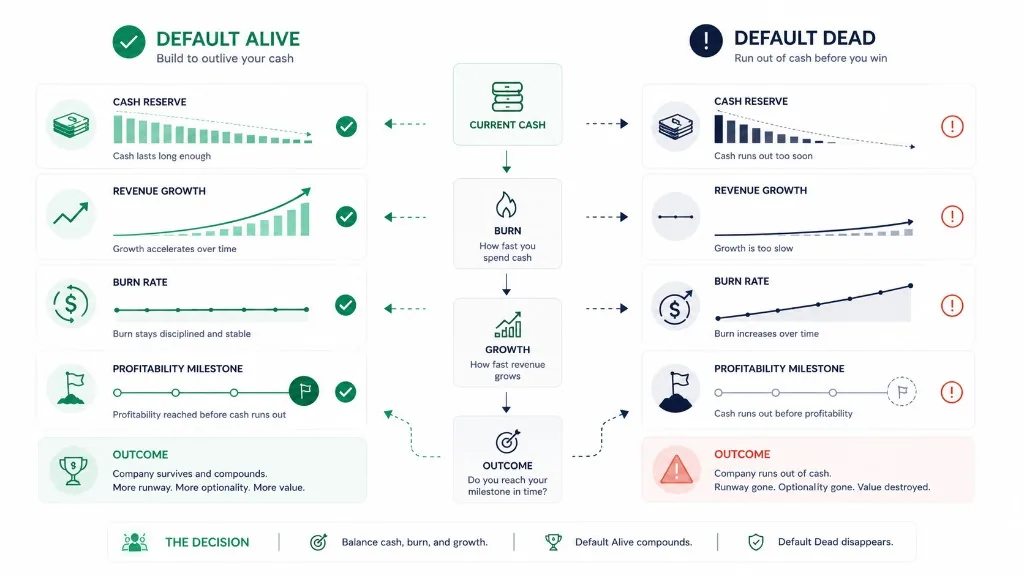
- Default alive vs default dead: whether you reach profitability on the cash you have.
- ARR vs cash: why recurring revenue and the bank balance disagree.
- Will I make payroll?: checking each payroll date against your cash.