Predictive cash flow forecasting projects how much cash your business will have on each date ahead, based on when money actually arrives and leaves, so you can see a cash shortfall weeks before it happens.
In treasury software, "predictive" usually means statistical or machine-learning models trained on payment history that predict when each invoice will be paid. This guide covers the practical version a small business can run: forecast on the dates money actually moves, date receivables by how each customer has paid before, and check the forecast against what happened every week. For the basics of cash flow forecasting itself, start with what is cash flow forecasting.
The Problem with How Businesses Think About Cash
Most businesses have a fundamental misunderstanding: they confuse expected revenue with available cash.
A signed contract won't pay your salaries. An invoice won't cover your rent. And even a profitable month can contain a brutal week where you're scrambling to keep the lights on.
Financial statements can show a company is doing great while its actual bank balance tells a completely different story.
Why? Because revenue, profit, and cash measure three different things:
- Revenue is what you've earned.
- Profit is what's left after expenses (according to accounting rules).
- Cash is what's actually in the bank to make payments.
This difference matters especially when customers pay on 30, 45, or 60 day terms. The cash conversion cycle measures how long that gap ties up your cash.
Predictive cash flow forecasting attempts to close that gap. Instead of just recording what already happened, it projects what could happen to your cash balance over the coming weeks and months.
It combines expected customer payments, recurring expenses, payroll, what's already in the bank, and some assumptions about the future to estimate how much cash you'll have on any given date. If you are new to the idea, what is cash flow forecasting? covers the basics and the methods.
A useful forecast doesn't just answer "Is the business making money?" It answers the immediate, scary question: "Will we have enough cash when we need it?"
The Cash Timing Trap: An Illustrative Scenario
Imagine you're running a business with $60,000 in the bank, $80,000 in monthly operating expenses, and $110,000 in outstanding invoices.
On paper, everything looks solid. Customers are paying on time, revenue is growing, and incoming invoices cover the month's bills.
Then a $65,000 payment from a key customer, originally due on November 9, gets delayed until November 30.
Payroll hits your books on November 13. Software subscriptions are automatically charged the following week. You've also promised a contractor some money before the month's out.
The business itself hasn't changed. The same revenue's coming in. The same contracts are still valid.
But the timing is off. And that three-week delay could completely throw off your cash flow.
Depending on when all the other payments land, that $65,000 pushback might mean you don't have enough liquidity to cover what you owe in these three weeks.
This sounds like a hypothetical, but it happens more often than you'd think.
The real question isn't whether you'll ever get that money. It's whether you can actually make payroll, pay the bills, and keep going until it arrives. The guide to knowing whether you will make payroll turns that question into a checklist.
How Do You Actually Measure a Cash Flow Forecast?
You measure a forecast by comparing what it predicted against what actually happened.
Here's an example:
| Measure | Amount |
|---|---|
| Forecast ending cash | $120,000 |
| Actual ending cash | $105,000 |
| Forecast variance | −$15,000 |
| Absolute percentage error | 12.5% |
The forecast was off by $15,000, or 12.5% of the forecast amount.
But that number alone doesn't tell you why. Maybe a customer paid two weeks late. Maybe a vendor invoice was bigger than expected. Maybe you hired someone earlier than planned.
Those distinctions matter.
A forecast that's wrong because receivables ran late requires a different fix than a forecast that underestimated expenses.
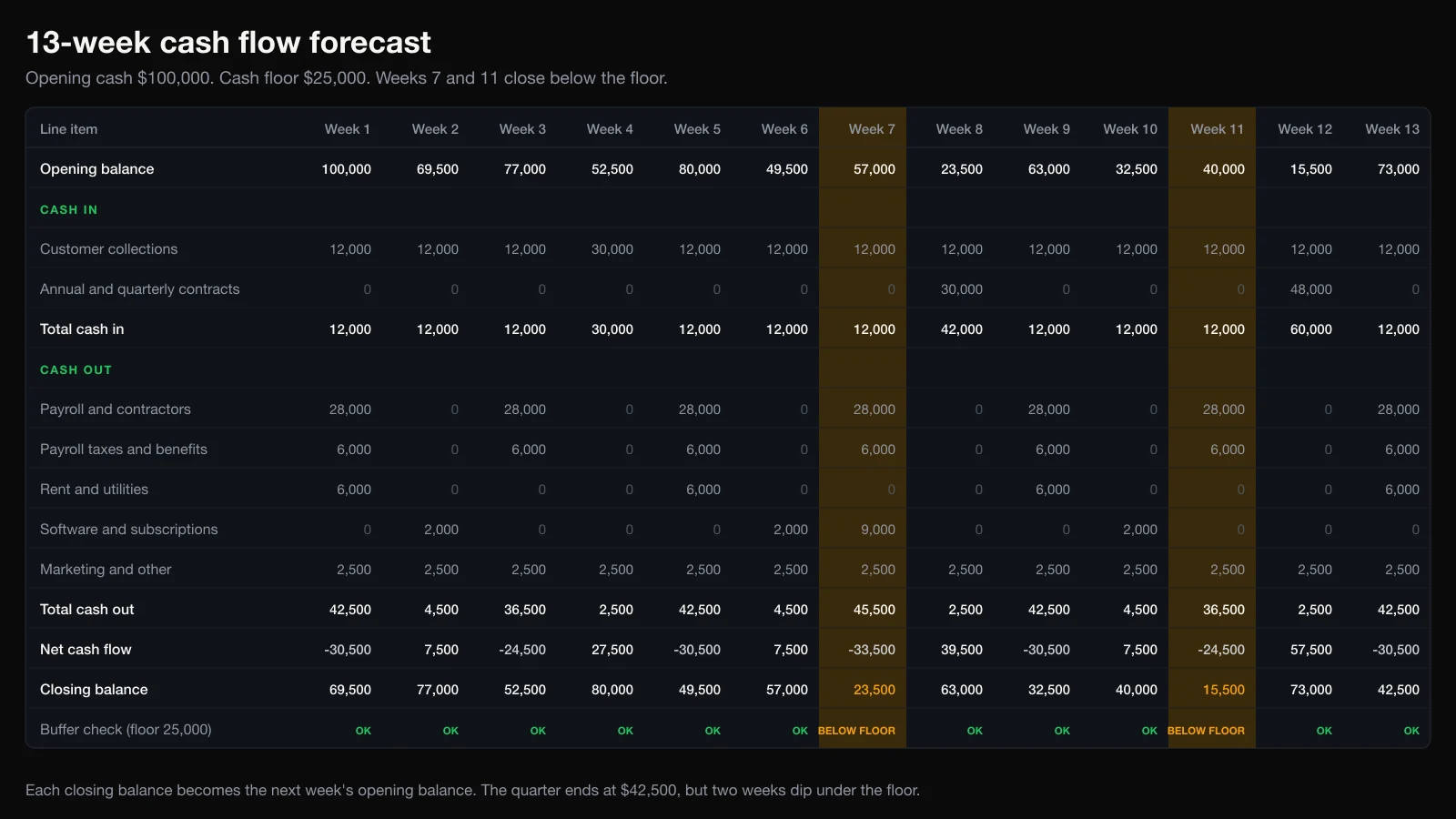
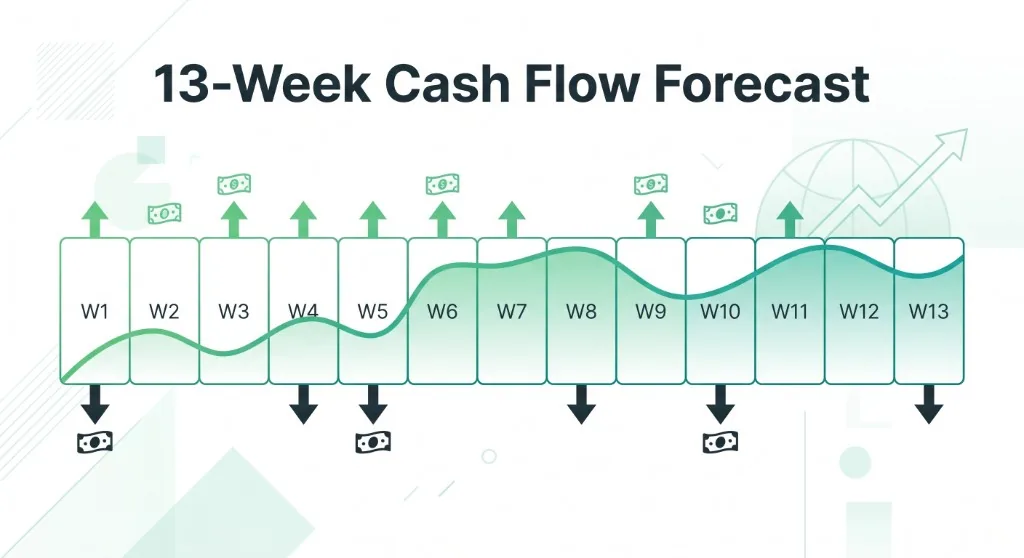
One practical approach? Maintain a rolling 13-week cash flow forecast.
At the end of each week, compare your original forecast against what actually happened: cash received, cash paid, and closing balance.
Then dig into the biggest differences. I'd look for three things:
- Which payments arrived later than expected?
- Which expenses were higher or came sooner than forecast?
- Are the same errors happening over and over?
The goal isn't to hit zero variance; that's unrealistic. The goal is to learn: Is your forecast getting better at representing how your business actually operates?
A forecast that consistently overestimates incoming payments is telling you something important about your assumptions, before a cash shortage happens.
Why Forecast a Range Instead of One Number?
A single forecast line can make an uncertain future look more predictable than it really is.
Imagine a business with $200,000 in cash, receiving $75,000 in customer payments monthly, and spending $90,000 a month.
At that rate, they're losing $15,000 in cash each month. That's the expected case.
But what if collections slow down? What if a major client stops paying? What if expenses jump unexpectedly?
A single forecast line doesn't communicate those risks.
Instead, think in scenarios:
| Scenario | Inflows per month | Outflows per month | Cash after 3 months |
|---|---|---|---|
| Optimistic | $90,000 | $85,000 | $215,000 |
| Expected | $75,000 | $90,000 | $155,000 |
| Pessimistic | $45,000 | $95,000 | $50,000 |
Each scenario starts with the same $200,000 cash balance but assumes different monthly amounts.
- The optimistic case shows what happens if collections improve and expenses dip.
- The expected case reflects current operating assumptions.
- The pessimistic case assumes incoming payments fall while expenses climb.
None of this predicts the future. It just shows how different assumptions affect your financial position.
The key: your worst-case scenario should be specific enough to explain what could actually go wrong.
Losing your largest customer is meaningful. Arbitrarily reducing revenue by 30% without a reason isn't helpful.
A forecast becomes more valuable when scenarios reflect real decisions or risks the business recognizes.
If losing a major customer would leave you with only $50,000 in cash after three months, management can examine that risk before it becomes a reality.
That might mean delaying a hire, renegotiating payment terms, or building a larger cash reserve.
The point of forecasting isn't to predict one outcome. It's to prepare for several.
When Does Money Actually Arrive?
The date money arrives can matter far more than the date revenue is earned.
Consider a small services business that invoices a customer $40,000 on November 2, 2026.
The invoice has 30-day payment terms, making it due on December 2.
But the customer typically pays 15 days after the due date.
That changes the expected cash receipt date to December 17.
Here's the timeline:
| Event | Date |
|---|---|
| Invoice issued | November 2 |
| Contractual payment due | December 2 |
| Expected actual payment | December 17 |
| Total time from invoice to payment | 45 days |
The business earned $40,000 in revenue, but it may not have that cash available for 45 days.
If monthly payroll is $25,000 and other monthly expenses are $20,000, the business must fund about $67,500 of expenses over the 45 days it waits for that payment.
That's a cash timing problem, even when the underlying work is profitable.
A traditional forecast based on monthly revenue might treat the $40,000 as a November inflow.
A better cash forecast uses the date the payment is realistically expected to arrive.
That distinction can change the entire picture.
The same principle applies to subscriptions, milestone payments, retainers, and outstanding invoices. For turning HubSpot invoices and subscriptions into dated inflows, see forecasting cash from HubSpot invoices.
Expected payment dates should reflect how customers actually pay, not just what's written on the invoice.
And when payment behavior changes, the forecast should change with it.
When Does Money Actually Leave?
Forecasting receivables is only half the battle. A business also needs to know exactly when its obligations will reduce the cash balance.
Expenses don't leave the bank in neat monthly averages.
Payroll might hit twice a month. Rent may be due on the 1st. Contractors might be paid after milestones. Annual subscriptions can create weirdly large one-time withdrawals.
Imagine this week:
A business starts Monday, November 9 with $35,000 in cash.
It expects a $30,000 customer payment on Friday, November 13.
But payroll of $28,000 is scheduled for Wednesday, November 11, and a vendor payment of $12,000 is due Thursday, November 12.
The cash position looks like this:
| Date | Cash movement | Amount | Closing cash |
|---|---|---|---|
| Mon, Nov 9 | Opening balance | $35,000 | |
| Wed, Nov 11 | Payroll | −$28,000 | $7,000 |
| Thu, Nov 12 | Vendor payment | −$12,000 | −$5,000 |
| Fri, Nov 13 | Customer payment | +$30,000 | $25,000 |
By Friday, the business expects to have $25,000 in cash.
But on Thursday, its projected balance falls to negative $5,000.
That shortfall exists even though the business ends the week with a positive forecast balance.
A company cannot wait until Friday to pay obligations due on Thursday.
And a bank account doesn't automatically permit a negative balance. Without a financing arrangement, the business could face failed payments, penalties, or delayed obligations.
This is why monthly averages can be dangerously misleading.
A forecast showing only the month-end balance might completely miss a cash shortage in the middle of the month.
Even a weekly closing balance can hide a shortage that occurs between payment dates.
For businesses with tight liquidity, the forecast needs enough detail to reveal those critical days. Payroll dates are the ones most often off by a week; the 2026 and 2027 payroll calendar lists every one for your schedule.
The question isn't just how much the company spends. It's when those payments compete for the same dollars.
How Do Cash Flow Forecasts Actually Fail?
Forecasts usually fail when the assumptions behind them stop reflecting reality.
And the most dangerous errors are often the ones that appear small at first.
The Customer Who Always Paid Late
A design agency forecasts $80,000 in customer collections for the month.
Historically, its largest customer pays about two weeks after the contractual due date. But the forecast assumes the payment will arrive on time.
The expected $35,000 payment doesn't arrive before payroll.
The agency has to delay a planned $20,000 contractor payment and arrange temporary financing to bridge the gap.
The forecast wasn't wrong about how much the customer owed. It was wrong about when the money would arrive.
That difference created an avoidable cash management problem. Cash flow forecasting for agencies works through this pattern in more detail.
The Expense That Wasn't in the Forecast
A growing software company expects to end the quarter with $95,000 in cash.
Its forecast includes regular payroll, cloud infrastructure, and software subscriptions.
But it excludes a $24,000 annual vendor renewal scheduled for the final month.
The company finishes the quarter with $71,000 instead of $95,000.
That's a 25.3% shortfall relative to the original projected balance.
A management team relying on the original forecast might have approved an additional expense or hiring commitment that its actual cash position couldn't comfortably support.
The problem wasn't an unpredictable market event. It was a known obligation missing from the model.
Both examples lead to the same lesson: A cash flow forecast is only as reliable as the assumptions and payment schedules behind it.
A forecast should be treated as a working model, not a static financial document.
When customers change their payment behavior, expenses increase, or the business makes new commitments, those changes need to appear in the numbers.
What Does Zensus Do, and What Doesn't It Do Yet?
At Zensus, we're building cash flow forecasting tools around a practical question: What will a business's cash position look like over the coming weeks, and which decisions could change it?
Our forecasting workflow is designed to help turn financial inputs into a clearer picture of future cash balances.
Zensus connects to your bank through Plaid, to QuickBooks, and to HubSpot, and works from your cash balances, expected inflows, and operating expenses to generate forward-looking projections by month, week, or day.
Rather than relying on a single projection, Zensus lets you model a scenario against the baseline forecast: a new hire, a lost customer, a one-off expense, or a change in revenue.
That makes it possible to examine how different assumptions could affect available cash.
We also focus on making forecasts useful for decisions.
For example, a business owner evaluating a new hire needs to understand more than the additional monthly salary expense. They need to understand how that commitment affects future cash balances, especially when incoming payments are uncertain.
The same applies to increasing contractor spending, adjusting operating expenses, or planning around a potential revenue shortfall.
But there are important limitations.
A forecast is not a guarantee, and no software can eliminate uncertainty from customer behavior or future business conditions.
A model can calculate the effects of an expected payment date, but that doesn't mean the customer will actually pay on that date.
Forecasting quality still depends on the completeness and accuracy of the financial information provided.
And a business shouldn't confuse automatically generated scenarios with independently verified predictions.
We're continuing to improve how Zensus represents the timing of receipts and payments, particularly where monthly financial data doesn't capture what happens within individual weeks.
The objective isn't to replace financial judgment. It's to give business owners and finance teams a clearer starting point for making decisions.
How Do You Start Forecasting Your Cash Flow This Week?
You don't need a complex financial model to begin.
Start with a spreadsheet and one hour of focused work:
- Write down the amount of cash available in your business accounts today.
- List the payments you reasonably expect to receive over the next 13 weeks. Include the customer, expected amount, and likely payment date.
- Record every known cash obligation during the same period. Include payroll, rent, contractors, debt payments, subscriptions, taxes, and any larger one-time expenses.
- Group these movements by week.
- For each week, calculate: Ending cash = Beginning cash + Cash received − Cash paid
- Carry the ending balance forward as the next week's beginning balance.
- Once you've completed the 13 weeks, find the week with the lowest projected cash balance. That's the first number I would examine.
- Then ask: What happens if your largest expected customer payment arrives two weeks late?
- Move that receipt to the later week and recalculate the balances.
- You now have two forecasts: one based on current expectations and another showing the impact of a specific payment delay.
The free 13-week cash flow template has these columns ready, and how to build a 13-week cash flow forecast in Excel walks through the formulas.
Neither forecast will be perfect.
But both are more useful than assuming every invoice will be paid exactly when you need the money.
From there, make the forecast a weekly habit.
Replace projected numbers with actual payments, record the differences, and update the assumptions that proved inaccurate.
Over time, the model should become a more accurate reflection of how your business collects and spends money.
The first forecast establishes your assumptions. Every update tests them. To add warning thresholds and alerts on top of the forecast, see the guide to a cash flow early warning system.
The Real Value of Knowing What's Ahead
A business doesn't usually experience a cash shortage all at once.
The warning signs can appear weeks earlier.
A customer starts paying later. Operating expenses creep upward. A planned hire increases fixed costs. A large payment falls into the wrong week.
Individually, those changes may seem manageable.
Together, they can put a business in a position it didn't anticipate.
Predictive cash flow forecasting gives business owners and finance teams a way to examine those possibilities before they become immediate problems.
It creates room to ask better questions while there is still time to act.
If your largest customer paid three weeks late, which obligation would become difficult to meet first?
Your forecast shouldn't be a promise. It should be a weather report.
Related guides:
- What is a 13-week cash flow forecast?: the weekly forecast this guide recommends, line by line.
- Zero cash date: how to find the week cash runs out, not just the month.
- Will I make payroll?: project cash to each payroll date and check it against your buffer.
- Can QuickBooks forecast cash flow?: what its built-in planner does and where it stops.